Who are Dr Anna Petersen and Lady Mildryth?

Daughter of Mercia is a timeslip/dual time novel with two main protagonists in each timeline. The two main characters I’ve chosen to tell you about are Dr Anna Petersen (in the present day) and Lady Mildryth (in the 6th century), both complex characters who are the spring-boards for the conflict and action of the novel as their lives intertwine. There are also two male main protagonists: Professor Matt Beacham and Theowulf who are crucial to the plot.

Dr Anna Petersen is in her early 30s, an academic, a medievalist and expert in runology. She’s called out to an archaeological dig by her old adversary Professor Matt Beacham, an archaeologist, who wants her to help in interpreting strange runes on an ancient seax he has discovered in a weird burial on his dig site. This is the starting point of the story. However, Anna is a little hesitant as she has come across Matt previously during an inter-university session on WhatsApp, when she took an instant dislike to him, feeling that he was arrogant and unapproachable. But she’s really fascinated by the burial itself as well as the found artefacts, because there are two remains in the same burial site, one female and early medieval, and the other male and modern. She determines to go to the site to examine the unusual runes and hopefully find out more about the mysterious burial, although she’s haunted by the memory of the last dig she took part in, where a dreadful event took place.

Anna is essentially a strong character, clever, kind and caring, usually well able to stand up for herself in a man’s world, but feels that, in a moment of weakness, she has allowed herself to be taken advantage of, professionally and personally, by her erstwhile colleague, Tom. She is now struggling with being able to trust again and her life is now largely about self-preservation. She also holds a dark secret in her heart related to that experience and she finds it difficult to talk to anyone about it, other than her friend Susie. She wishes she could confide in her beloved mother, but as she is suffering from a terminal illness, Anna doesn’t want to worry her. As her father died long ago, Anna is her mother’s primary carer and the sole custodian of the historic family home and archives. It’s a lot for her young shoulders to bear! And it doesn’t help that Matt seems to blame her for the disappearance of their mutual colleague, Tom.
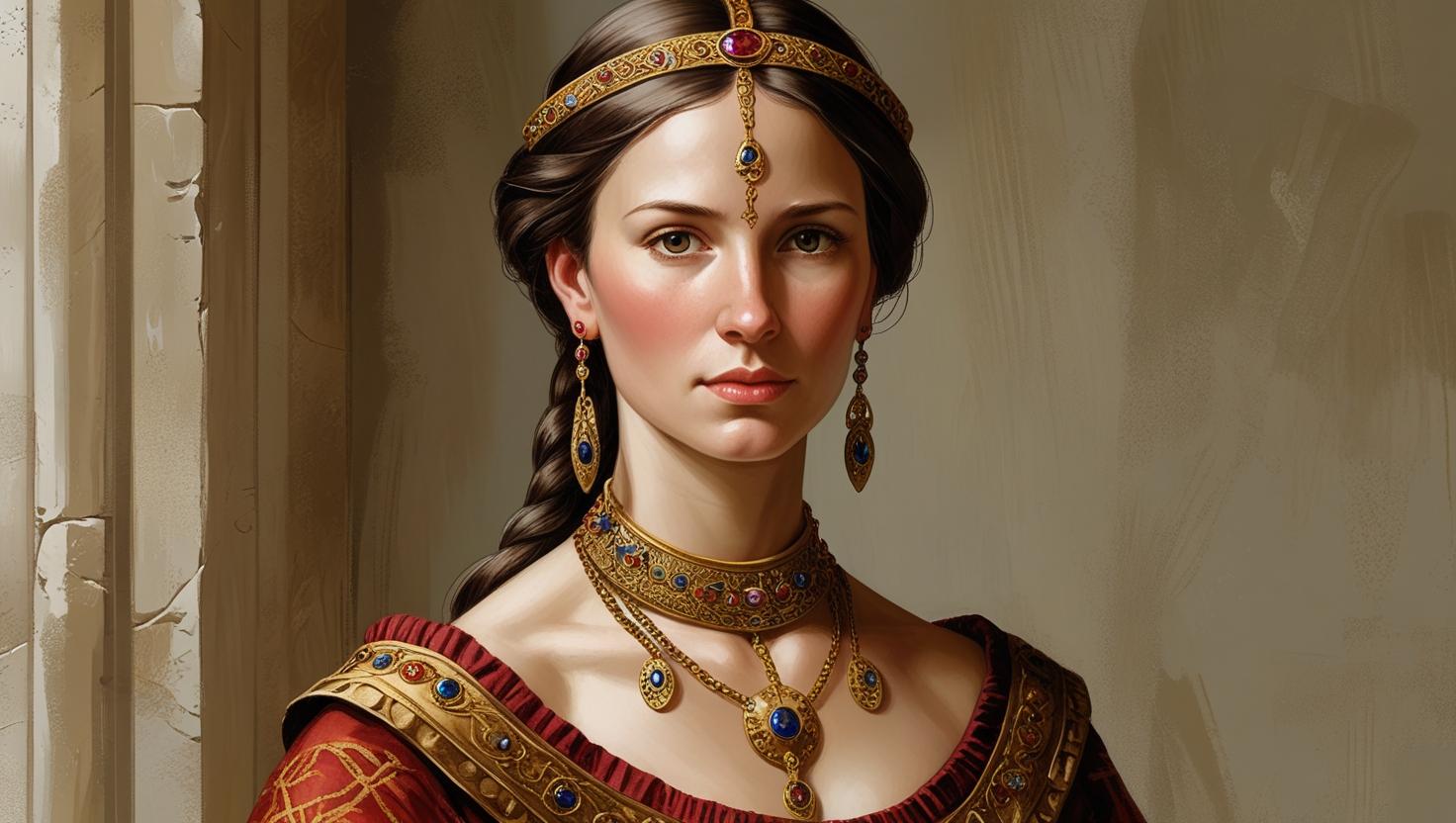
Lady Mildryth is the young leader of the settlement and its region granted to her by her father, King Cnebba of Mercia. She is named the cūning (‘king’), a title given to male and female leaders although she feels that she must impress her father that she is undoubtedly equal to men, in particular to her brothers who have also been granted small ‘kingdoms’. She feels that she is constantly being spied upon and judged by her father and therefore, although she’s a strong leader, needs to convey an image of strength and wisdom at all times: whether it may be in her dealing with problems within the settlement, or in her image in the Witan council where decisions are made. She’s annoyed with herself when she thinks that she has fallen short of the ideal she has set for herself.

Mildryth needs to be the final arbiter of disputes, the wise head who decides the fate of erring subjects, the judge of appropriate punishments for misdeeds, and the leader who forms the strategy in terms of relationships with neighbouring settlements and of the advisability of battle. She wants nothing more than a peaceful and flourishing future for her people and that is what she sees as her role, not as a warring, blood-thirsty despot or a conquering dictator. Success for Mildryth is the unity of a settled community with plentiful harvests, food stored for harsh winters, and the development of cultural activities, such as the scōp (poet story-teller of historic heroic tales) and the glæman (for music and singing). She follows the new Christian faith but accepts that many of her people still hold to the pagan beliefs of old, and tries to accommodate both views. It’s important for her to maintain harmony in the community. Like Anna, it’s a lot for her young shoulders to bear! Yet, she is still a ‘child of her time’ and when the real challenge comes in the form of an almost unbelievable reality, can she take it?

It is Mildryth’s name that Anna interprets from the runes on the seax hilt in Daughter of Mercia, and thus begins the connection between the two women across the centuries. Both of them experience odd ‘visions’ of each other’s life and times, as Anna starts to discover more about Mildryth’s challenges: her domineering father, her position as leader, and her relationship to the stranger who appears in her settlement, whom she names as Theowulf. In more ways than one, Mildryth challenges the conventions of her time and as a strong, brave and determined young woman she has much in common with Anna. But little do either of them realise how much more they have in common than personality alone. As Anna talks to her bed-bound mother she finds out about her father’s family history and it reveals a whole new dimension to her investigation into the seax, the burial, and to Mildryth herself.

I hope that Daughter of Mercia is a gripping page-turning read, but also that it is thought-provoking and leaves the reader wondering! As one of my reviewers said: ‘I couldn’t stop talking about it for days’.

If you want to read more about Lady Mildryth’s period of history, I have a series (Living with the Anglo Saxons) on my blog here at https://juliaibbotsonauthor.com

My Book Blast one day tour – exhausting!

Exhausting, yes, but exciting! Today I’ve been on tour, from the comfort of my study and my laptop. No waiting around on chilly train stations, or driving with one eye on the satnav trying to get to an unfamiliar venue on time in a strange city, or wondering whether anyone will turn up to the event. No. Another of my virtual book tours, this one with Coffee Pot Book Club tours which specialises in historical novels. They’re at https://thecoffeepotbookclub.blogspot.com/ and the book bloggers are dedicated readers and authors. Do check it out as there are some fabulous sites out there enthusing about books set in all historical periods. I’ve been focusing on virtual book blog tours since covid struck and have continued ever since. So much more relaxing, cosy – and guaranteed audience! Check them all out.

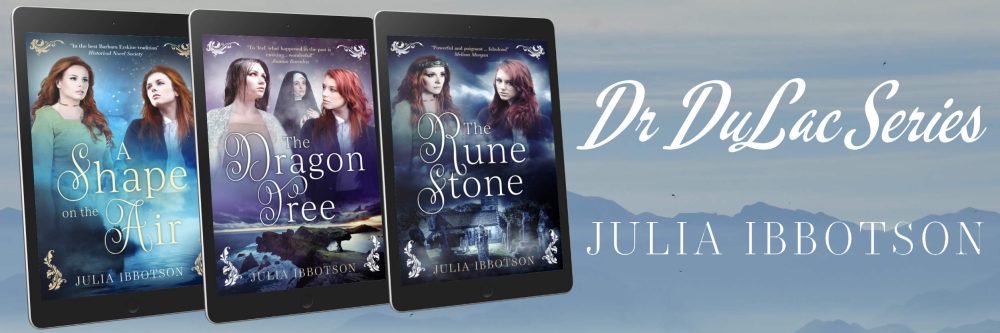
Today was all about the first of my Dr DuLac series (A Shape on the Air) at https://myBook.to/ASOTA a haunting early medieval (Anglo Saxon) timeslip of mystery and romance. It was a reminder of the start of my historical dual time novels as a prelude to further tours for my latest … so

… exciting times: I have two more tours to come, these with my latest novel Daughter of Mercia https://myBook.to/DOMercia 11-17 August with https://zooloosbooktours.co.uk/ and 21 August – 11 September with https://thecoffeepotbookclub.blogspot.com/

Goodness, I’ll be busy this summer!

Exciting new book! Daughter of Mercia, at last

Finally, after many delays, my latest haunting early medieval dual time mystery romance is out there in the world! The blurb:

Echoes of the past resonate across the centuries as Dr Anna Petersen, a medievalist and runologist, is struggling with past trauma and allowing herself to trust again. When archaeologist (and Anna’s old adversary) Professor Matt Beacham unearths a 6th century seax with a mysterious runic inscription, and reluctantly approaches Anna for help, a chain of events bring the past firmly back into her present. And why does the burial site also contain two sets of bones, one 6th century and the other modern?

As the past and present intermingle alarmingly, Anna and Matt need to work together to solve the mystery of the seax runes and the seemingly impossible burial, and to discover the truth about the past. Tensions rise and sparks fly between Anna and Matt. But how is 6th century Lady Mildryth of Mercia connected to Anna? Can they both be the Daughter of Mercia?

For fans of Barbara Erskine, Elena Collins, Pamela Hartshorne, Susanna Kearsley and Christina Courtenay.

Take a look at https://myBook.to/DOMercia

Virtual Book Tours: what are they?

I love virtual book tours! And above you’ll see an image form one I did recently. But for the uninitiated – what are they?

We’ve all seen (or heard of) authors touring round venues with their new book, doing signings, giving talks, with a schedule of stops/events in a variety of places over a period of maybe a week or two. Nice for the audience of potential readers/followers to meet their writer idol, but exhausting for the poor author! For many of us it can get ‘a bit too much’ – and also interrupt the progress of the next book!

So, virtual book tours – what are they, how do they work, and do they help with promoting a book? I’ve often been asked this by fellow authors. They’ve been around for a while now but they really took off in Covid lockdown when authors couldn’t travel around doing physical face-to-face talks/meet and greet/book signings. That’s when I got hooked!

You don’t need to spend precious time travelling, you do it all online from your desk. Your tour ‘stops’ over a period of 5, 7 or maybe 14 days are book enthusiasts’ blogs on Facebook, twitter, Instagram etc. You may choose to do all-review tours or you may want to provide guest posts, or simply ask for a feature post. In all cases your book cover and details such as a short blurb, author profile, social media links, buy-links etc are posted.

It’s also a better way for readers who may not be able to make a physical event because of other commitments or difficulty travelling to a venue far away or because of health or disability factors. And anyone can access the blog stop and read about a new or favourite author or their new publication! The tour organiser spreads the news of the tour and the links to the stops, on all their socials. They should also provide the author with the schedule containing all the dates on tour and the direct links to each blog/feature. For me, that’s a much more effective promotional tool.

I’ve used virtual book tours for a few years now and can really recommend them – as long as you do your research and choose carefully. There may be a bit of trial and error in finding the tours that suit you and your writing best. Over the years I’ve tried out several. Now I have three that I use regularly, either with a newly published book or to refresh interest in a novel that’s been out there for a while. But there are some I have tried and rejected mainly either because the organiser was too disorganised or they didn’t keep me informed with posts or feedback. Some are ridiculously expensive for what they purport to provide (and some don’t actually fulfil their brief), so look at a range and see how much they vary.

My recent tour is illustrated above – or at least one of the images from the wrap-up from the tour, which gave me some quotations from the reviews. This is one such. Personally, I have a favourite specialist tour for historical novels, because you know that the audience is looking for that genre (although the potential reader may be interested in a different historical period from the one you write in!), a favourite specialist tour for romance, and a more general tour for all genres of novels.

Whether they result in an immediate tsunami of sales or not depends on a number of factors. But they certainly increase your profile, and perhaps bring your name and work before potential new readers. That has to be good!

A Shape on the Air can be found at https://myBook.to/ASOTA

and its sequels, and all my books at https://Author.to/JuliaIbbotsonauthor

Living with the Anglo-Saxons (6): what about the healthiness of the diet?

In the last blog, I looked at what we know about food and drink in the Anglo-Saxon period. In many ways it might seem to us today that the Anglo-Saxon diet was healthy: no sugar, no fast foods, no ready meals, no additives, no processed foods – all the things dietitians and nutritionists are concerned about these days. So we tend to make assumptions based on our 21st century perspectives of a ‘healthy diet’ or ‘unhealthy foods’. We don’t have the Anglo-Saxon perspective on this!

The paucity of skeletal evidence from bio-archaeological or osteo-archaeological findings make it difficult to assess disease and chronic illnesses of the period. Our assumptions might be that there was lower incidence of obesity, heart disease, cancers because the diet consisted for many people of fresh fruit and vegetables, cereals, fresh meat and fish (although the latter two were more prevalent in the diet of the higher status Anglo-Saxons). And we might assume that this would lead to an increase in dental health, average height, increased recovery rate from infections. But without documentary or widespread archaeological evidence it’s hard to make generalisations.

We do know that there would have been a reliance on seasonal fresh produce because preservation was hard, which could be a problem if the harvest was affected by climate or major weather systems and this would be a vulnerability for Anglo-Saxon settlements. For example, there is evidence of a major volcanic eruption in the mid-530s which caused significant climate change, cold, darkness, ruined harvests. The resulting famine, hunger and starvation, would result in increased disease and deaths. We also know that there was a significant pandemic of bubonic plague in 541-2. Although this may not have been caused by diet it would certainly have ramifications on food production and availability.

The lack of food preservation techniques would exacerbate this vulnerability. There were few means to preserve perishable foodstuffs, apart from drying, smoking, and salting. Salt became such a precious commodity that some might be paid in salt, and social status was marked by how near or far you sat from the salt at feasts (‘above or below the salt’ was a common expression, being ‘below the salt’ indicating lower status). Foods such as fish and meat would be encased in salt for preservation, but it was also used to mask the taste of bad food.

Rotten perishable food was a significant health risk, but it was arguably not entirely widely recognised in this period. We think that it tended to be thought that it was the taste of bad food that was the problem, rather than the bacteria in rotting food. So, as a result, the Anglo-Saxons were keen to disguise the taste of bad food with salt, herbs and marinades. There would have been a significant risk of illness from food poisoning, from meat from cattle that were carriers of disease, and a weakening of strength when physical activity was paramount for the life of the community.

What about Anglo-Saxon medicine? Bald’s Leechbook (9th century) available in the British Library, and other documents, provide some interesting evidence of the way illness and disease was treated in this period. For example, various treatments were advised for wounds, throat infections, skin conditions and some for more serious diseases. Herbs were used for infusions, ointments, salves and poultices (eg an eye salve from garlic), and recipes are given for problems such as nettles for muscular pain. Eating animal liver is cited as a ‘cure for the plague’. The Leechbook suggests a concoction of leek, garlic, wine and bullock’s gall, which was reported in 2015 as a potion that could potentially kill methicillin-resistant staphylococcus aureus (MRSA)!

A final thought: there is emerging evidence from Anglo-Saxon sites in Cambridgeshire and Kent from the analysis of human skeletal remains for carbon and nitrogen isotopes that suggest diverse diets based on wealth and social status. For example, some studies suggest that higher status, wealthier Anglo-Saxons ate more meat and fish, and lower status people ate more vegetables, and possibly were, in some case, largely vegetarian. This is an ongoing analysis, but it would be interesting to know whether this related to the level of health. 

PS Would you like to know more about life in the Anglo-Saxon period? My novel A Shape on the Air is set in 499 AD as Angle and Saxon tribes began to settle in Britain, although of course this happened over the course of several centuries.

http://myBook.to/ASOTA

Living with the Anglo-Saxons (5)

What about Anglo-Saxon food and drink?

Earlier in 2021 I was delighted to be asked to speak to the Leeds Symposium on Food, Drink and Health, which develops learning on these aspects of historical research. My session was, of course (!) on the Anglo-Saxon period. The following is based on some of the research I outlined in the session …

There was a rich mead hall culture in Anglo-Saxon times; the mead hall was where the community feasts were held and was a focal point in the village or settlement. ‘Mead’ was the common alcoholic drink made from honey, widely drunk, and especially at communal meals, thus the hall was named after it.

Literary evidence from the 7th or 8th century heroic poem Beowulf (the dating isn’t clear) indicates the riches of the hall and its decoration: ‘tapestries worked in gold glittered on the walls’, ‘eofor-līc scionon ofer hlēor-bergan: gehroden golde’ (‘boar-crests glittered above the helmets adorned with gold’), ‘māđm-æht’ (‘precious treasures’), ‘bēag-gyfa’ (the treasure-giver, or lord/leader/chieftain/king). The feasting and drinking is emphasised in the poem and many Anglo-Saxon words emphasise the importance of mead: ‘medo-ful’ (the mead cup), ‘medo-benc’ (the mead benc), ‘medu-drēam’ (revelry in mead-drinking and feasting).

There would be entertainment during the meal: a scōp would be employed, the poet/musician who entertained with ‘harp and voice’ (not a harp as we know it), and the poetry and story-telling would celebrate both traditional Christian and pagan heroic deeds and values. These narrative poems would honour and glorify the community and unify the society.

The mead hall was the centre of the pre-Anglo-Saxon and Anglo-Saxon village community. It was important as the Witan council, the decision-making meeting, was usually held in the mead hall and often before a feast. Wooden trestle tables were used for eating and could be dismantled or set up easily and quickly for council meetings. It was the focus of village life, eating and drinking together consolidated the stability of the community.

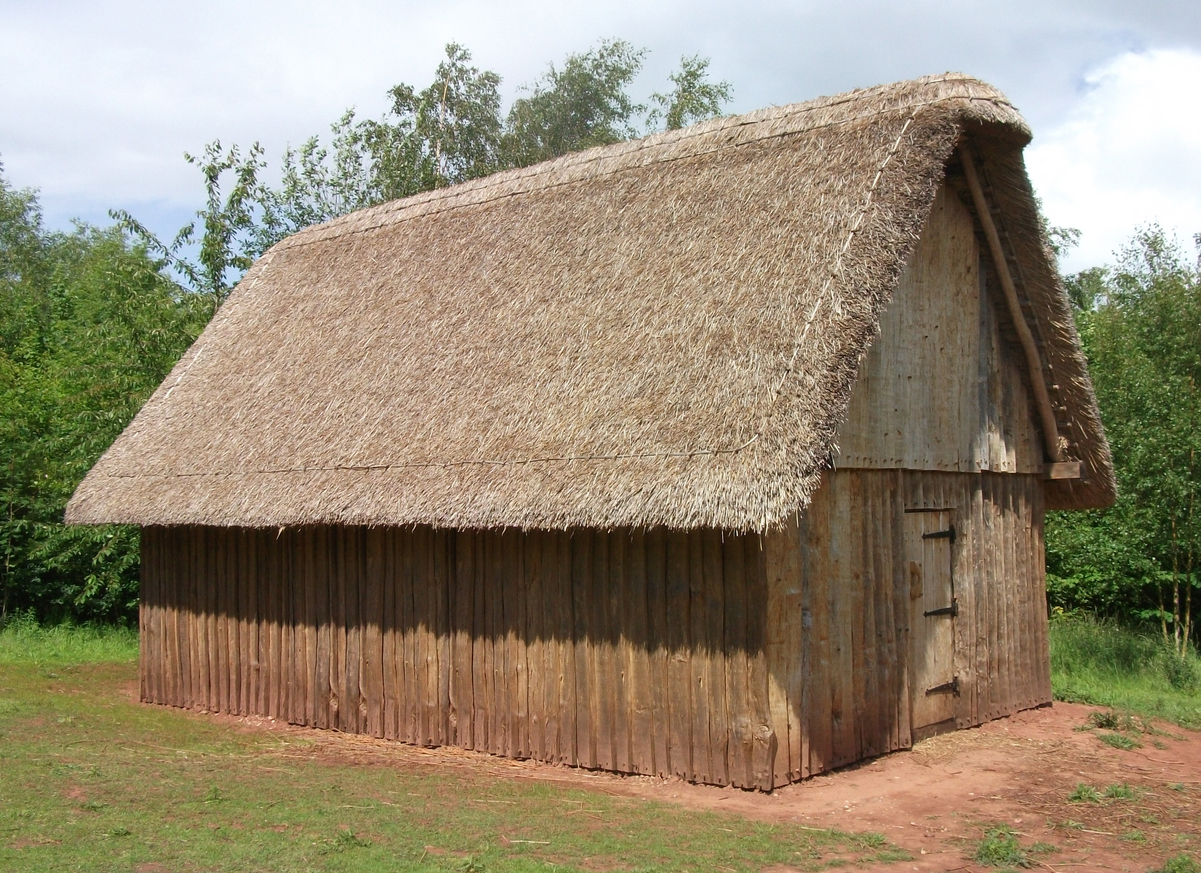
Reconstruction of Dark Ages Anglo-Saxon thatched wooden hall, built at Bishops Wood Centre, Worcestershire, England.

Feasts in the mead hall would be frequent in Anglo-Saxon times, and feast days for the whole community were usually held according to the journey of the moon: commemorating the full moon, new moon, winter solstice, summer solstice, etc.

But the general feasts were not necessarily for everyone in the village. There was a strict hierarchy. The serfs would serve at tables and they and the cooks would eat separately, but they still ate similarly to the thegns, ealdormen and ladies. The ceorls (lower class free men) might be included at table if they held a particular office. But the gebūrs (not in serfdom but keeper of ‘rented’ allotment of land) would not usually be included. The serfs, never.

There would be a ‘high table’ with the cūning/cyning (king/leader), ealdormen and high thegns. At right angles down the hall were the trestle tables for the other nobles. They would be used mainly at noon and evening for communal eating; evening meals in winter were by the light of flaming ‘torches’ in sconces on the wall and hanging cressets filled with oil. There would usually be a huge firepit in the middle of hall. 

Whether in the mead hall or in their own houses, most Anglo-Saxons would use wooden bowls, platters and spoons. Everyone had their own knife (a seax or small version of a seax), worn in a leather pouch hanging from their belt at their waist. The wealthier people would have drinking horns for mead and perhaps even glass goblets for wine.

Although there is evidence that the Anglo-Saxons imported dates, figs, raisins and almonds, these would be for the wealthy. But berries and nuts from the hedgerows were plentiful for all. There is also evidence that agriculture changed from primarily arable to grazing land and there would be livestock for meat: eg chicken, cattle, pigs, sheep, ducks. There was often settlement provision and also individual families kept animals for food within their own living quarters: usually pigs and hens, often a cow. So dairy was accessible: milk, butter, cheese, eggs.

Settlements were usually sited near to rivers, for transport rather than drinking as the water was often contaminated (thus beer and ale were popular as well as mead) and fish would be caught, using simple nets, traps and line: trout, salmon, eels, perch, pike and even cockles, scallops and oysters.

On arable land and on the little patches of land next to individual houses, Anglo-Saxons would grow vegetables for the table: leeks (used for health remedies too), beans, peas, turnips, onions. Geburs might rent a patch of land for vegetables.

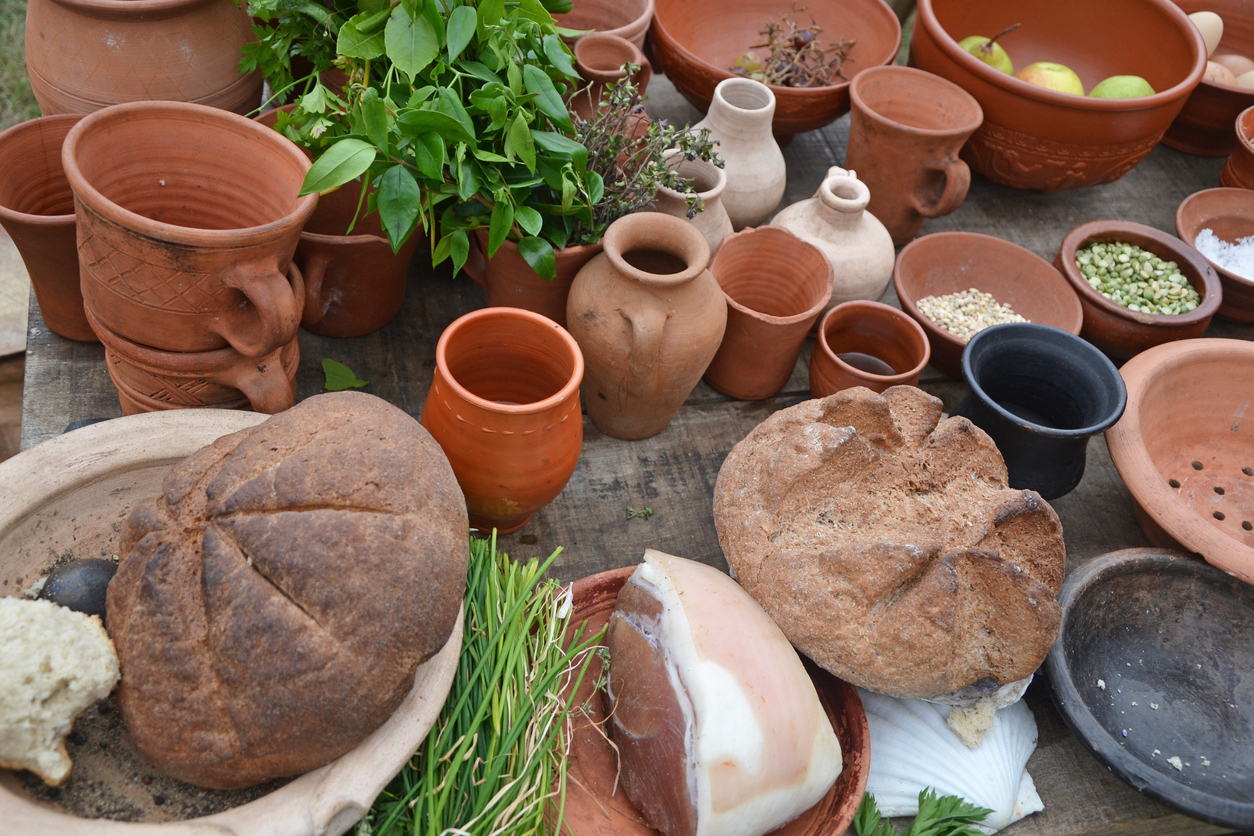
Arable farming produced spelt, wheat (for bread), rye, barley (for ale), oats (for bread, porridge, cakes). Ancient recipes indicate that bread could be made with ground wheat (flour) and water only, no salt (too precious!) or oil or yeast. Salt was extremely precious because it was the main source of food preservation and often used to mask the bad taste of rotting meat. Herbs were also used for this purpose as well as to flavour and tenderise, for marinades, etc.

There was no sugar, so honey was widely used to sweeten food and drinks (hence honeyed mead). Honeyed bread was a delicacy!

NB further reading:

Ann Hagen (2010) Anglo-Saxon Food and Drink: production, processing and consumption (Anglo-Saxon Books)

Debby Banham (2004) Food and Drink in Anglo-Saxon England (The History Press)

In the next blog, I’ll be looking at how healthy/unhealthy the Anglo-Saxon diet seems to be …

You might like to read more about those times, a fascinating period of English history, in my novel A Shape on the Air. It’s an Anglo-Saxon time-slip mystery available on Amazon at

http//:myBook.to/ASOTA

Living with the Anglo-Saxons (3)

What would an Anglo-Saxon ceorl’s house look like?

Reconstruction of Dark Ages Anglo-Saxon thatched wooden hall, built at Bishops Wood Centre, Worcestershire, England.

The image above gives you some idea – they would be wooden and thatched, which is why so little from that time has survived.

A ceorl’s house was basic with few adornments, unlike the homes of the wealthy higher classes, and would have looked to us more like large huts or barns. Indeed the animals would share the room with the family. Ceorls were ‘freed-men’ and often were in charge of a portion of fields or livestock. The family’s own animals, bred for food or milk, were housed at one end of the house for winter shelter: a goat, a cow, a sheep.

The house would measure around 10 metres by 5 metres with wooden floors which could be covered with fragrant herbs. The walls were of upright planks of wood slotted together or of wattle and daub. There were window openings, but no glass, and a central hearth for cooking. There was no chimney and often no hole for the smoke to escape, so the living quarters would have been very smoky and unpleasant especially in winter when the animals joined the family indoors. The roof would be thatched and blackened by the smoke. Bedding would be perhaps a large bag stuffed with straw or wool if the family had sheep to shear.

The family’s table would be a trestle arrangement that could be easily taken down and stored between meals. Food would need to be hung high in the roof, away from predators. They would eat whatever they could acquire from their animals, mainly chicken, pork, beef and lamb, their small plot of land for vegetables, and the hedgerows for berries. Their diet would be fresh as there were few ways of storing: salt was precious for preserving meat, for instance, and ice-houses only for the wealthy. They would drink ale rather than water which was often contaminated. Wine was rare in a ceorl’s house but frequently drunk in the chieftain’s hall. Bread made from spelt, rye or oats, could be baked in communal basic ovens. There was little sugar in their diet and skeletal remains show good dental health. For a sweetener they used honey from their own or communal hives, and this is one of the main ingredients of the favoured alcoholic drink of mead.

Water for washing and cooking could be collected in pots from the stream or village well, if they were lucky enough to have one accessible. The ceorl’s home would have a small plot of land outside the building for vegetables for the family’s use, and nearby a ‘midden’ or primitive toilet area, the contents of which would be used for manure on the vegetable plot.  

For more, you may like to read my novel A Shape on the Air, an Anglo-Saxon mystery time-slip, set in the present day and 499 AD grounded in detail on domestic life of the time, available at

http://myBook.to/ASOTA

Living with the Anglo-Saxons (2)

What did the early Anglo Saxons wear?

Certainly not animal skins wrapped around their torsos, the popular image of ancient Britons, nor togas left over from the Roman occupation of Britain! From the 5th to the 7th century clothing was perhaps surprisingly well refined and often richly dyed and decorated, especially for the higher classes of society. Of course, it depended on your social class, and the lower classes wore simpler garb of rougher cloth (working class serfs, peasants and even geburs who kept small parcels of land, and ceorls who were freedmen). But even so, the garb was not unlike our clothes today. For the higher ceorls and the thegns and their ladies, clothes were highly decorated and accessorised by brooches of gold and jewels.

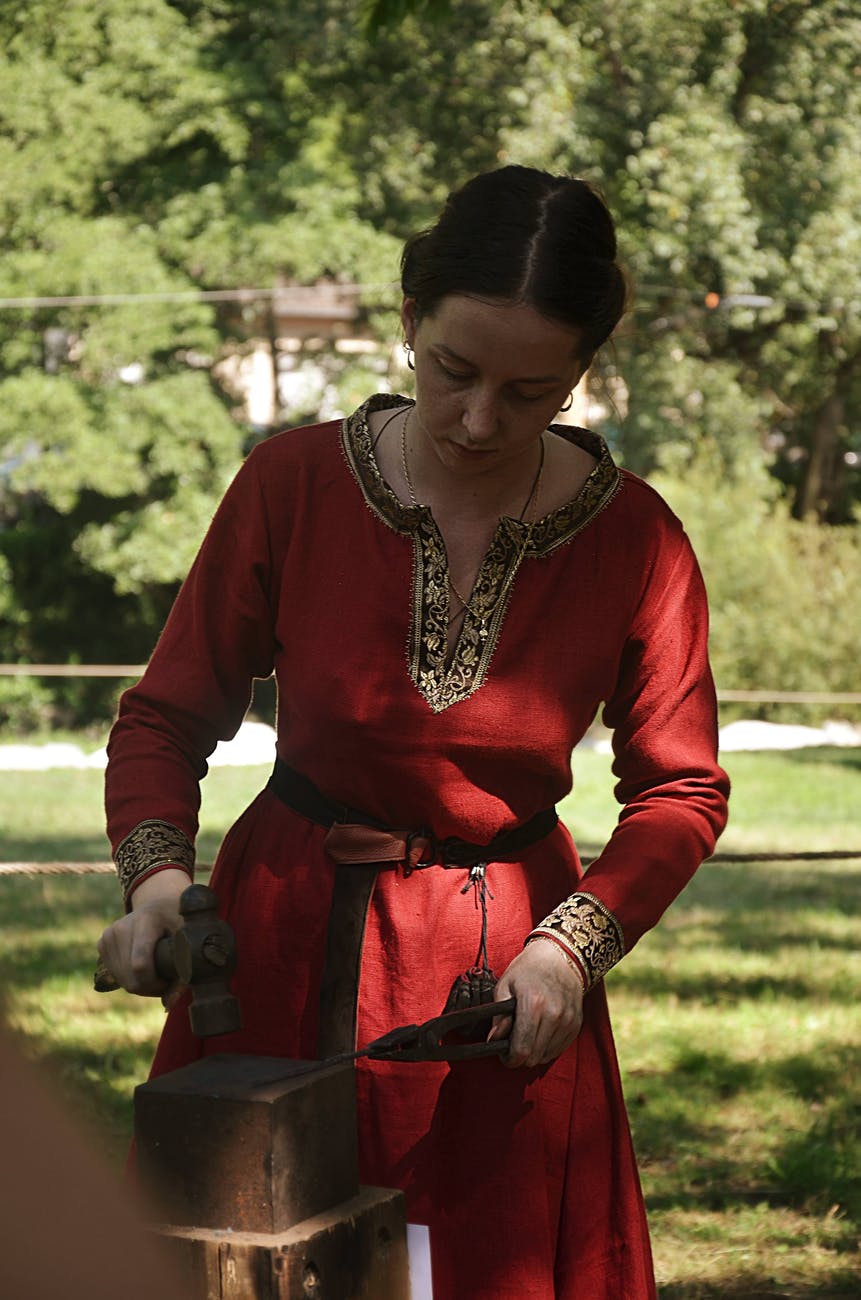
Upper class ladies often wore several layers, as heating even in the richest houses was rudimentary: a chemise or shift in linen or wool, then on top of this,  a long sleeved full-length under-dress, or kirtle, again of linen or wool or maybe a soft cotton fabric from lime tree fibres. On top was an over-gown dyed with more expensive dyes such as deep reds, purples and blues and lavishly trimmed with braid or fur. It would be fixed around the waist with a leather belt from which hung a pouch for keys and other valuables, a cross between a modern-day pocket and a purse or bag. On top would be an embroidered mantle or cloak fixed with a gold brooch at the shoulder, often jewelled or metalworked. Later in the period, kirtles would be fashioned with gores lined with silk or brocade to match the over-gown or trim.

Photo by Pexels User on Pexels.com

Ladies’ hair would be twisted and bound or braided. Unmarried girls wore their hair more loosely. Headwear for ladies was a head rail often decorated with silver-work or jewels which fixed the veil beneath. Later, ladies tended to wear a type of wimple and veil reminiscent of nuns or a coif or crespine.

What of the men? As you might expect, theirs were simpler than the ladies. Men of lower class would wear simple tunics, often rough-spun with hose beneath, with higher class thegns and above sporting woollen or linen undergarments and woollen hose beneath their tunics topped with heavy fur-lined cloaks, fixed with gold brooches. Heavy leather belts held daggers and knives not just for fighting but for cutting food in the mead hall feasts.

Photo by Maria Pop on Pexels.com

For more about Anglo-Saxon life, why not read my novel, A Shape on th Air, a time-slip from the present day to 499 AD

http://myBook.to/ASOTA

A corner of Derbyshire – Chatsworth: nooks and crannies

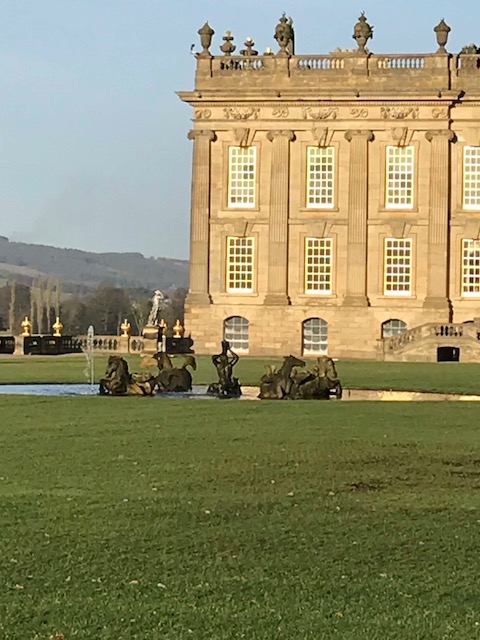
If asked to name a stately home in Derbyshire, and although there are many houses worth a visit (Haddon Hall, Hardwick Hall, Kedleston Hall and more), I would guess that most of us would know Chatsworth, near Bakewell (famous for pudding – not ‘tart’, thank you!) the home of the Duke of Devonshire and home to the Cavendish family since 1549, passed down through 16 generations.

Until recently we lived in Derbyshire and enjoyed nearby areas that many folks would choose to visit for holidays or days out. Chatsworth was always somewhere to take walks through the beautiful grounds or nose around the grand rooms. But I was also interested in its fascinating history.

Chatsworth sits on an estate the size of Washington DC and has played host to many famous people from Mary Queen of Scots, Elizabeth I, Charles Dickens to John F Kennedy.

It’s also been host to many scandals. The decadent and glamorous 18th century Duchess Lady Georgiana  Spencer, wife of the 5th Duke and ancestor of Diana, Princess of Wales, who, like her descendent, talked of the third party in her marriage, one Lady Elizabeth Foster who moved in with them as a menage de trois. Georgiana herself was locked in scandal, her tumultuous financial affairs bringing her notoriety.

There was also the matter of a scandalous affair between JFK’s favourite sister, Kathleen, and the Devonshire heir William (Billy) Cavendish, who was subsequently killed in action in WWI.

In the summer of 2018, a ‘secret’ in the garden was revealed. The long extraordinarily hot summer scorched the lawns and revealed the outlines of the geometrically designed flower beds and paths from 1699 – before Capability Brown’s design at the house? Its existence was known, although never seen for generations, as it’s illustrated in a painting in the Chatsworth Collection in the House.

2018 also brought another dramatic event. The lavish house had been carefully renovated over 10 years and was finally revealed in all its glory. Each window on the west and south terraces was revamped in 1500 sheets of gold leaf at a cost of about £33 million and 4000ft of fabric was used to repair the curtains.

One of the secrets I would have liked to seen revealed would be the designs of the fashion icon Georgiana, but apparently the clothes were made from such fine and expensive fabric that they were either reused or handed down to her Lady’s maid. Lucky maid!

PS. A number of my novels are set in Derbyshire: A Shape on the Air, for example, Dr Viv works at the university and Rev Rory is vicar of a small parish in the county, and the two sequels coming soon (The Dragon Tree and The Rune Stone) continue the setting. Available at http://myBook.to/ASOTA