
A Ghanaian market, a scene from Drumbeats where Jess waits for Chrissie
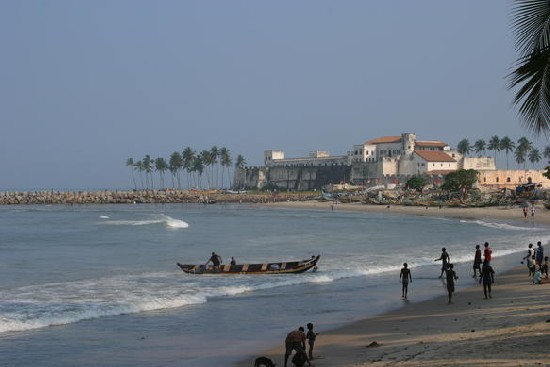
The beach near Cape Coast, Biriwa Beach, a scene from Drumbeats where Jess goes with Jim after the horrors of visiting the old slave castle
A Ghanaian market, a scene from Drumbeats where Jess waits for Chrissie
The beach near Cape Coast, Biriwa Beach, a scene from Drumbeats where Jess goes with Jim after the horrors of visiting the old slave castle
Here it is!
The story of love, joy, tragedy and danger set against the backdrop of a war-torn African country …
So here at last is the link to my new novel, Drumbeats, available from Amazon, in both Kindle ebook and paperback formats:
A reminder of the cover too!
It’s very exciting as it’s already won an award at the Hollywood Book Festival 2014 (this month, July) when it was barely hot off the press. I’m touring with it in September with Fiction Addiction Book Tours and have a couple of articles on Indie Author News coming up in August. I’ll post the links when they appear. We’ll also be at the Festival of Romantic Fiction in Leighton Buzzard in September; will link that later on too.
This coming week I’m going to be busy creating a book trailer video to post up here shortly. Hope you enjoy it!
What a lovely chat with the wonderful Janice Ross yesterday on US blogtalkradio show, Saturday Cultural Cocktails! The hour flew by so quickly. We talked about my new book Drumbeats which is due out in the next couple of weeks and will be available through Amazon in paperback and ebook formats. Because it’s set in Ghana (West Africa) in the 1960s we talked about preparation for writing, ie research, and how to become immersed in the atmosphere of a book so that you can write authentically. We talked about my “little box of tricks”, tips for writers, and the fine line between fiction and reality. Do I log in the back of my mind places and people I meet so that I can use them in my novels? Well, maybe, but they have a habit of changing and going their own way as I write. Hear more if you click on the link below …
http://www.blogtalkradio.com/culturalcocktails/2014/06/28/saturday-cocktails-w-julia-Ibbotson

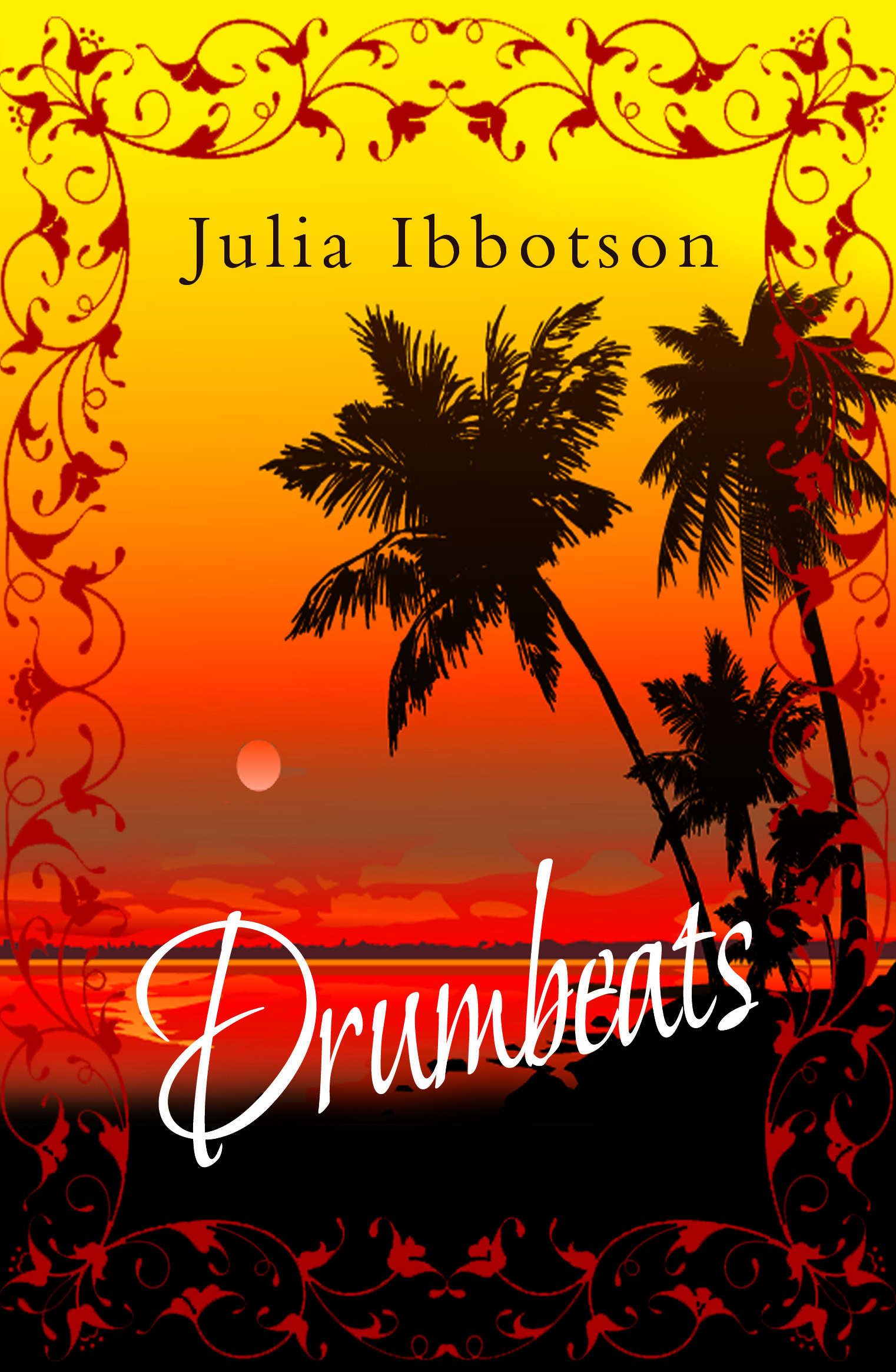 My new novel, Drumbeats, is the first of a trilogy following Jess through her life. Drumbeats starts it all off in the mid-1960s as eighteen year old English student, Jess, flees to West Africa on a gap year, escaping her stifling home background for freedom to become a volunteer teacher and nurse in the Ghanaian bush. Apprehensively, she leaves her first real romantic love behind in the UK, but will she be able to sustain the bond while she is away? With the idealism of youth, she hopes to find out who she really is, and do some good in the world, but little does she realise what, in reality, she will find that year: joys, horrors, tragedy. She must find her way on her own and learn what fate has in store for her, as she becomes embroiled in the poverty and turmoil of a small war-torn African nation under a controversial dictatorship. Jess must face the dangers of both civil war and unexpected romance. Can she escape her past or will it always haunt her?
I have reviewed this on my Books I Like page but wanted to post it as a blog here too as it is circulating the review lists again.
What a stunning achievement this novel is! Sometimes you read a book and wish so much that you had had the same idea! It was so very clever. I was totally engrossed in the notion of many layers of a life trying over and over to get it right (the multi-universe/parallel universe/quilted universe concept).
A baby, Ursula, is born on 11th November 1910 in a terrible snowstorm. The umbilical cord is caught around her neck and the doctor is unable to arrive in time so save her. Cut to 11th November 1910 again. This time Ursula survives. But still she is caught up in events that are unacceptable. Ursula’s death and rebirthing recurs until finally the course of history is set right. What an engaging and thought-provoking concept. How wonderful it would be to believe in this. Turn back the clock and try again. Yes, I can relate to that in my own life – probably most of us could. The evocations of periods of history are well-researched, rich and appear authentic. I felt that some parts were perhaps a little overdone, like the blitz narratives and maybe the novel could have benefitted from some culling of these episodes, but the rest was so engaging that I still gave it 5 stars. Highly recommended.
Wow, excellent book. Dani Atkins weaves an intriguing story which traces two different lives which Rachel may or may not have lived over the previous five years following an accident. The ending is superb and interweaves all the mysterious hints wonderfully competently. I love books that leave me thinking and working out the intricacies. Well recommended.
I’ve just read some of the other reviews and am amazed at the number of readers who simply didn’t “get it”! One at least totally misunderstood the ending.
I do agree with one reviewer about the problematic issue of the actual car accident where the vehicle seems to take forever to crash through the window of the restaurant, and the unrealistic trapping of Rachel behind the table, and yes, I would agree that this could/should have been edited down to a page or two only – but compared with the rest of the book this paled into insignificance. The rest was a very powerful story and I couldn’t stop thinking about it for some days afterwards.
Deep significant looks, heaving bosoms, and silent tortured expressions seemed to characterise this film. There was a lot of walking with determined strides across gloomy sand dunes and the lawns at Gads Hill. There were the dark claustrophobic Victorian rooms crowded with people admiring the great writer, heavy and airless with fawning and grovelling.
I have mixed feelings about this film: on the one hand I enjoyed the Dickens references to Great Expectations and flashes of the writer’s life which I already knew about, but on the other I found what was omitted from the story rather annoying. Ralph Fiennes valiantly tried to depict Dickens as a romantic but flawed genius but we know that he (Dickens, not Fiennes!) was relentlessly cruel to his wife and children, and that his dalliance with Nellie (Ellen Ternan) came at a great price for his family, however much he and his adoring friends and public endeavoured to cover up his affair and uphold the fantasy that he was the archetypal upstanding paragon of Victorian values.
Granted it was focusing on Nellie’s story, the teenage actress who captured the attention of the great writer who was many years her senior, but the reality of it all is that his vanity fed on the destruction of those around him and this did not really come through the film.
Other odd gaps were for example when at one moment Nellie was furiously claiming that she would not be his mistress and horrified that he should suggest such immorality (“how could he offend her virtue so?”) and the next she was living with him, trotting off with him to France, and bearing his child. The only thing in the film that seemed to prompt this was Dickens’s suggestion that their relationship was akin to Pip and Estelle!
Another big gap in the film was the leap from Dickens setting Nellie up in her own house and Nellie being married to a headmaster and with a child. And another disparity: in Victorian times jobbing actresses were regarded as little more than “women of the night” while in the film we are led to believe that Nellie and her family are poor but respectable.
I do think that perhaps the film suffered from the cutting room …?
I’ve just finished reading The Book Thief and I know already that it will be one that haunts me for a long time. It is brilliant, in its style, its structure and its message. I love unusual narratives, with creative startling language, and this one is crafted so beautifully that it makes the reader gasp. The last words from Death say it all (and I don’t think that I give anything away by quoting them): “I am haunted by humans”. It’s what pervades the whole novel.
It is set in 1939 in Nazi Germany, and it is, uniquely, I think, narrated by Death himself. The characters are clearly formed and the reader gets to know each one. The main protagonist is Liesel, the foster girl who comes to live with Rosa and Hans Hubermann in their house in a poor area outside Munich. Hans (“Papa”) teaches her to read and write, and this forms the beauty of the story. She forms a firm friendship with Rudy, the boy next door, and together they eke out their meagre existence by stealing food and colour their survival with words. The family harbours in their basement, Max, a Jew for whom Hans has reason to be grateful, and he develops Liesel’s fascination with words. She begins to steal books and shares them with Max and with her neighbours in the shelter during the devastating bombing raids. Liesel and Rudy’s growing understanding of the world around them is shown carefully and delicately through the eyes of Death.
There is so much to this book that a brief review can barely suggest the experience of reading it. The beauty (and sometimes oddness)of the language had something of the poet Dylan Thomas about it. I have read many novels about this period of history and thought that there was nothing new to say, but this one is most unusual and captivating. It certainly left me with much to think about. I can’t wait to see the film; I do hope that it serves the book well.
 juliaibbotsonauthor