So thrilled to be a Finalist in the Readers’ Book Awards for Book of the Year 2025! And then to be awarded a medal! Thank you so much, Coffee Pot Book Club. It’s like an early Christmas present.
Troubled medievalist Dr Anna Petersen and her old adversary, archaeologist Professor Matt Beacham, must unravel mysterious runes on an Anglo-Saxon seax found at a weird burial containing both 6th century and modern remains. My latest novel has garnered some really lovely readers’ comments:
“a beautifully crafted historical romance with a time travel twist”,
“richly layered with sensory detail”,
“brings both the past and the present timelines to life”,
“solidly researched and authentic”,
“a page turner”,
“engrossing”,
“beautifully crafted”,
“utterly compelling”,
“fast paced, a rivetting plot!”
and more …! Wow! Thank you so much, all my dedicated readers, old and new. What a great end to 2025. If you haven’t yet read it, it’s available at
I love virtual book tours! And above you’ll see an image form one I did recently. But for the uninitiated – what are they?
We’ve all seen (or heard of) authors touring round venues with their new book, doing signings, giving talks, with a schedule of stops/events in a variety of places over a period of maybe a week or two. Nice for the audience of potential readers/followers to meet their writer idol, but exhausting for the poor author! For many of us it can get ‘a bit too much’ – and also interrupt the progress of the next book!
So, virtual book tours – what are they, how do they work, and do they help with promoting a book? I’ve often been asked this by fellow authors. They’ve been around for a while now but they really took off in Covid lockdown when authors couldn’t travel around doing physical face-to-face talks/meet and greet/book signings. That’s when I got hooked!
You don’t need to spend precious time travelling, you do it all online from your desk. Your tour ‘stops’ over a period of 5, 7 or maybe 14 days are book enthusiasts’ blogs on Facebook, twitter, Instagram etc. You may choose to do all-review tours or you may want to provide guest posts, or simply ask for a feature post. In all cases your book cover and details such as a short blurb, author profile, social media links, buy-links etc are posted.
It’s also a better way for readers who may not be able to make a physical event because of other commitments or difficulty travelling to a venue far away or because of health or disability factors. And anyone can access the blog stop and read about a new or favourite author or their new publication! The tour organiser spreads the news of the tour and the links to the stops, on all their socials. They should also provide the author with the schedule containing all the dates on tour and the direct links to each blog/feature. For me, that’s a much more effective promotional tool.
I’ve used virtual book tours for a few years now and can really recommend them – as long as you do your research and choose carefully. There may be a bit of trial and error in finding the tours that suit you and your writing best. Over the years I’ve tried out several. Now I have three that I use regularly, either with a newly published book or to refresh interest in a novel that’s been out there for a while. But there are some I have tried and rejected mainly either because the organiser was too disorganised or they didn’t keep me informed with posts or feedback. Some are ridiculously expensive for what they purport to provide (and some don’t actually fulfil their brief), so look at a range and see how much they vary.
My recent tour is illustrated above – or at least one of the images from the wrap-up from the tour, which gave me some quotations from the reviews. This is one such. Personally, I have a favourite specialist tour for historical novels, because you know that the audience is looking for that genre (although the potential reader may be interested in a different historical period from the one you write in!), a favourite specialist tour for romance, and a more general tour for all genres of novels.
Whether they result in an immediate tsunami of sales or not depends on a number of factors. But they certainly increase your profile, and perhaps bring your name and work before potential new readers. That has to be good!
My genre for the past few years has been (and still is, really!) decidedly historical fiction, mainly early medieval time-slip, Anglo-Saxon in particular. But my earlier novels were more modern (twentieth century). I’m told that ‘history’ is prior to 50 years ago, so I guess they too are within the historical novel genre. Drumbeats opens in 1965.
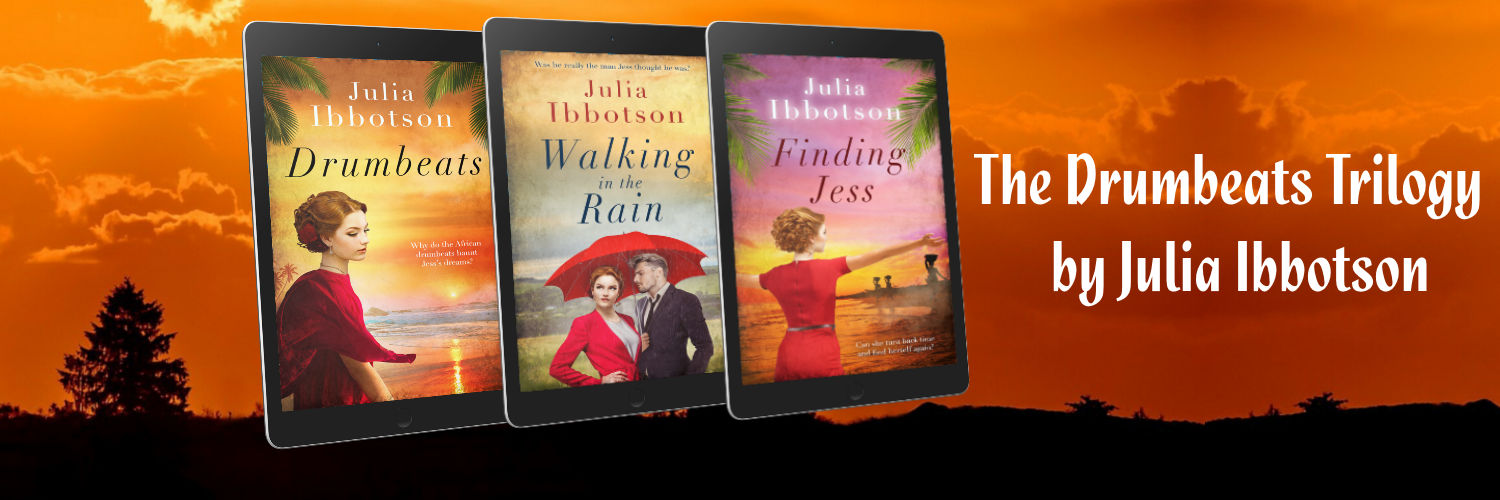
My news is that the Drumbeats Trilogy has just been re-published and re-released with a new publisher and with lovely new covers and some minor revisions. I hope you like the new covers; I think they’re more eye-catching than the previous ones from my last publisher. The trilogy starts in the mid-1960s with Drumbeats when 18 year old Jess goes off to Ghana, West Africa, on her gap year, to teach and nurse in the bush villages. It’s a year of joy and tragedy, loss and discovery. The series continues with Walking in the Rain through Jess’s life of uneasy compromises in the 1970s to 80s, to Finding Jess in the early 1990s and finally sees her return to Ghana and her second chances of happiness. The trilogy is a feel-good exploration of one woman’s rise above adversity and the triumph of hope and love.
I’m on book tours with the new editions through the autumn – do look out for the flash discounts to celebrate the new covers and the tours!
I seem to be on a mission to revamp my remaining books too, having moved to a new publisher, so The Old Rectory and my children’s book S.C.A.R.S will also be flaunting new covers and new editions soon. The Old Rectory is the story of rescuing an old early Victorian house and the exploration of the historical food and drink that would have been prepared in its kitchen, while S.C.A.R.S is a fantasy time-slip tale based on medieval literature.
And currently, I’m also working on a new series of Anglo-Saxon time-slip/dual time novels set in Mercia, with a new protagonist, a specialist in interpreting runes, who joins up with an archaeologist to solve strange mysteries of the past.
Anglo Saxon women: peace-weavers or shield-maidens?
I was interested to catch up with Kathleen Herbert’s excellent little book “Peace-Weavers and Shield Maidens” (2013, first published in 1997) on the image of women in early English society. She begins by commenting that people often tend to think of ‘English life’ as dating from 1066 whereas the first account of the ‘English’ (the ‘Anglii’, a Germanic race) was in Cornelius Tacitus’s ‘Germania’ in 98 AD and they worshipped a goddess, Nerthus (among other gods). As an aside, I’m not so sure about the 1066 bit – I would have said that people do tend to think of the Anglo Saxons from the 5th/6th centuries as the original ‘English’, despite the fact that before those migrants hit our shores the population comprised mainly Britons and Celts.
However, the stories and legends focusing on women, Herbert suggests, tend to fall into two archetypes: we might call them peace-weavers and shield-maidens. Herbert argues that women did fight and lead troops in early history, but were also literally and metaphorically peace-weavers, often through expedient marriages to form alliances with other kingdoms to avert potential strife. This seems to have been a widespread tactic to retain peace. Women might also be shield-maidens, literally or metaphorically as strategists in times of conflict. The two terms might well be interlinked and overlapping.
This is not to say that there weren’t violent battles for supremacy of a geographical region, that new kingdoms were not formed through victory in war. Of course, we have evidence of many battles leading to changes in power across different regions. But we also have evidence of deals and negotiation to co-exist.
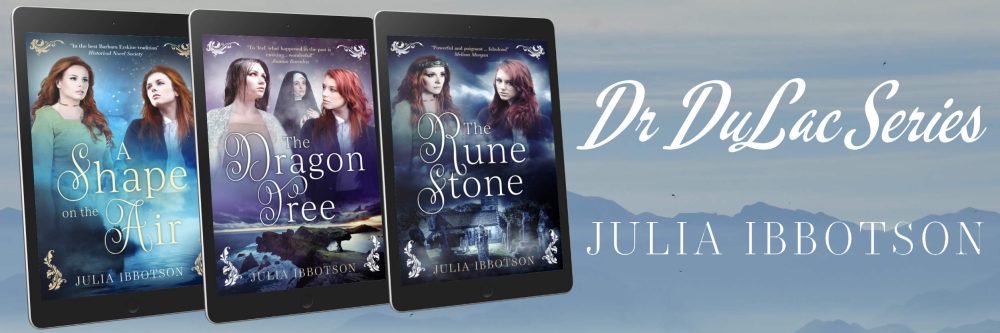
Britain was composed of many small kingdoms, and kingdoms fought to take over other kingdoms and thus wield greater power over a larger region. But our theories of this time of great change are beginning to recognise the way that stable everyday life and the quest for peace were also significant. Hence, in my Dr DuLac Anglo-Saxon time-slip series (#1 A Shape on the Air and especially its #3 sequel, The Rune Stone, coming out soon), I have Lady Vivianne (early 6th century ‘cūning’ or king/queen) as “peace-weaver”, although her husband is a fighting warrior. Her elevation to respected status over other kingdoms, and especially that of the Icelings in The Rune Stone, is to all intents and purposes that of honorary “warrior”, a status almost always used for men who were normally the fighters, but this is as a result not only of her strategising but also of her peace-making abilities.
Yes, the term “peace-weaver” was often used for women who brought peace between two kingdoms through marriage, but it was also used for women who were more active on their own account in the forging of peace between kingdoms, as Lady Vivianne is depicted as undertaking in my series. These female leaders could be strategists, not necessarily fighters joining battle; they could be mainly working for the defence of their kingdom: active peace-makers. These were leaders whose warrior status was conferred not by fighting but by directing. Annie Whitehead (in Women of Power, 2020) refers to a saying about Ǣthelflaed, the10th century Lady of the Mercians and daughter of King Alfred, who strategized battles to take Derby, Leicester, York, that she was a “man in valour, a woman in name”. So, to all intents and purposes we can take Lady Vivianne as one who, like Ǣthelflaed, is a brave and courageous ruler; she is a true “cūning” and “peace-weaver”.
Read about Lady Vivianne and her present day counterpart Dr Viv DuLac in A Shape on the Air at http://myBook.to/ASOTA
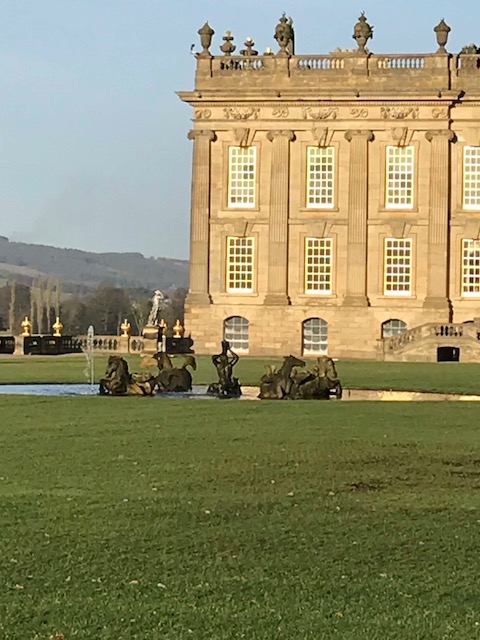
If asked to name a stately home in Derbyshire, and although there are many houses worth a visit (Haddon Hall, Hardwick Hall, Kedleston Hall and more), I would guess that most of us would know Chatsworth, near Bakewell (famous for pudding – not ‘tart’, thank you!) the home of the Duke of Devonshire and home to the Cavendish family since 1549, passed down through 16 generations.
Until recently we lived in Derbyshire and enjoyed nearby areas that many folks would choose to visit for holidays or days out. Chatsworth was always somewhere to take walks through the beautiful grounds or nose around the grand rooms. But I was also interested in its fascinating history.
Chatsworth sits on an estate the size of Washington DC and has played host to many famous people from Mary Queen of Scots, Elizabeth I, Charles Dickens to John F Kennedy.
It’s also been host to many scandals. The decadent and glamorous 18th century Duchess Lady Georgiana Spencer, wife of the 5th Duke and ancestor of Diana, Princess of Wales, who, like her descendent, talked of the third party in her marriage, one Lady Elizabeth Foster who moved in with them as a menage de trois. Georgiana herself was locked in scandal, her tumultuous financial affairs bringing her notoriety.
There was also the matter of a scandalous affair between JFK’s favourite sister, Kathleen, and the Devonshire heir William (Billy) Cavendish, who was subsequently killed in action in WWI.
In the summer of 2018, a ‘secret’ in the garden was revealed. The long extraordinarily hot summer scorched the lawns and revealed the outlines of the geometrically designed flower beds and paths from 1699 – before Capability Brown’s design at the house? Its existence was known, although never seen for generations, as it’s illustrated in a painting in the Chatsworth Collection in the House.
2018 also brought another dramatic event. The lavish house had been carefully renovated over 10 years and was finally revealed in all its glory. Each window on the west and south terraces was revamped in 1500 sheets of gold leaf at a cost of about £33 million and 4000ft of fabric was used to repair the curtains.
One of the secrets I would have liked to seen revealed would be the designs of the fashion icon Georgiana, but apparently the clothes were made from such fine and expensive fabric that they were either reused or handed down to her Lady’s maid. Lucky maid!
PS. A number of my novels are set in Derbyshire: A Shape on the Air, for example, Dr Viv works at the university and Rev Rory is vicar of a small parish in the county, and the two sequels coming soon (The Dragon Tree and The Rune Stone) continue the setting. Available at http://myBook.to/ASOTA




 juliaibbotsonauthor