Living with the Anglo-Saxons (6): what about the healthiness of the diet?

In the last blog, I looked at what we know about food and drink in the Anglo-Saxon period. In many ways it might seem to us today that the Anglo-Saxon diet was healthy: no sugar, no fast foods, no ready meals, no additives, no processed foods – all the things dietitians and nutritionists are concerned about these days. So we tend to make assumptions based on our 21st century perspectives of a ‘healthy diet’ or ‘unhealthy foods’. We don’t have the Anglo-Saxon perspective on this!

The paucity of skeletal evidence from bio-archaeological or osteo-archaeological findings make it difficult to assess disease and chronic illnesses of the period. Our assumptions might be that there was lower incidence of obesity, heart disease, cancers because the diet consisted for many people of fresh fruit and vegetables, cereals, fresh meat and fish (although the latter two were more prevalent in the diet of the higher status Anglo-Saxons). And we might assume that this would lead to an increase in dental health, average height, increased recovery rate from infections. But without documentary or widespread archaeological evidence it’s hard to make generalisations.

We do know that there would have been a reliance on seasonal fresh produce because preservation was hard, which could be a problem if the harvest was affected by climate or major weather systems and this would be a vulnerability for Anglo-Saxon settlements. For example, there is evidence of a major volcanic eruption in the mid-530s which caused significant climate change, cold, darkness, ruined harvests. The resulting famine, hunger and starvation, would result in increased disease and deaths. We also know that there was a significant pandemic of bubonic plague in 541-2. Although this may not have been caused by diet it would certainly have ramifications on food production and availability.

The lack of food preservation techniques would exacerbate this vulnerability. There were few means to preserve perishable foodstuffs, apart from drying, smoking, and salting. Salt became such a precious commodity that some might be paid in salt, and social status was marked by how near or far you sat from the salt at feasts (‘above or below the salt’ was a common expression, being ‘below the salt’ indicating lower status). Foods such as fish and meat would be encased in salt for preservation, but it was also used to mask the taste of bad food.

Rotten perishable food was a significant health risk, but it was arguably not entirely widely recognised in this period. We think that it tended to be thought that it was the taste of bad food that was the problem, rather than the bacteria in rotting food. So, as a result, the Anglo-Saxons were keen to disguise the taste of bad food with salt, herbs and marinades. There would have been a significant risk of illness from food poisoning, from meat from cattle that were carriers of disease, and a weakening of strength when physical activity was paramount for the life of the community.

What about Anglo-Saxon medicine? Bald’s Leechbook (9th century) available in the British Library, and other documents, provide some interesting evidence of the way illness and disease was treated in this period. For example, various treatments were advised for wounds, throat infections, skin conditions and some for more serious diseases. Herbs were used for infusions, ointments, salves and poultices (eg an eye salve from garlic), and recipes are given for problems such as nettles for muscular pain. Eating animal liver is cited as a ‘cure for the plague’. The Leechbook suggests a concoction of leek, garlic, wine and bullock’s gall, which was reported in 2015 as a potion that could potentially kill methicillin-resistant staphylococcus aureus (MRSA)!

A final thought: there is emerging evidence from Anglo-Saxon sites in Cambridgeshire and Kent from the analysis of human skeletal remains for carbon and nitrogen isotopes that suggest diverse diets based on wealth and social status. For example, some studies suggest that higher status, wealthier Anglo-Saxons ate more meat and fish, and lower status people ate more vegetables, and possibly were, in some case, largely vegetarian. This is an ongoing analysis, but it would be interesting to know whether this related to the level of health. 

PS Would you like to know more about life in the Anglo-Saxon period? My novel A Shape on the Air is set in 499 AD as Angle and Saxon tribes began to settle in Britain, although of course this happened over the course of several centuries.

http://myBook.to/ASOTA

Living with the Anglo-Saxons (4)

What would an Anglo-Saxon village look like?

West Stow Anglos Saxon Village in Suffolk, East Anglia in England is a fascinating recreation of an Anglo Saxon Village.

The Anglo-Saxon village or settlement consisted of wooden thatched huts, ceorls’ houses, and larger timber halls for the thegns, usually single storey and all grouped around a central mead hall and large chieftain’s hall. In many cases, these could be combined into one large ‘long hall’. The mead hall served as the venue for feasting with huge celebratory banquets, although generally restricted to the wealthy thegns and ealdormen, and as a place for meetings, sometimes referred to as ‘moot halls’ , the moot being the council meeting or gathering where the higher rungs of society met to discuss the settlement’s important matters of defence, judgement and punishment, tythes or food provisions. A large mead hall might contain rooms for the family of the chieftain (or cūning). As the period progressed halls became bigger and more splendidly furbished to signal the chieftain’s power and status. Recent archaeological work has uncovered huge halls for such purposes.

Even the early Anglo-Saxon villages would be fortified against raiders and would have a band of warriors ready to fight for their society’s protection and security. There would be stables for horses, granaries for storing precious grain, and along the dirt roads would be clusters of tradesmen’s workshops often with wooden shelves or counters outside, displaying their wares: the wood-worker, the metal-worker, the communal bakery, the baker, the weaver, the pottery kiln, and so on. When coinage was scarce, trade was often through exchange or barter of goods or services.

Thatched single-room huts of wattle and daub or wood comprised much of the settlement and these were often flanked by small plots allowed for vegetable growing for the family’s own use (the precursor of our gardens) and middens for human sewage – which proved invaluable for manure to fertilise the vegetable plot!

Gradually the Anglo-Saxons moved away from their pagan heritage and by the 6th century were embracing Christianity, partly through missionaries from Rome or Celtic lands, and simple timber churches could be found in settlements, often adopting pagan sites such as burial mounds, sacred wells or standing stones as their locations.

By the later period, the 9th  to the 10th centuries, we might expect to see the wide development of village churches, still often timber built which didn’t survive the ages, but which later developed in size, architecture, building materials and adornments as the period continued. Many village churches of today bear evidence of their Saxon and Celtic origins, perhaps where they were built in stone (rare) or reveal a Saxon cross in the churchyard.

NEXT TIME: Anglo-Saxon diet and health …

For more about Anglo-Saxon life, my Anglo-Saxon/present day time-slip with mystery and a touch of romance can be found at:

http://myBook.to/ASOTA

Living with the Anglo-Saxons (3)

What would an Anglo-Saxon ceorl’s house look like?

Reconstruction of Dark Ages Anglo-Saxon thatched wooden hall, built at Bishops Wood Centre, Worcestershire, England.

The image above gives you some idea – they would be wooden and thatched, which is why so little from that time has survived.

A ceorl’s house was basic with few adornments, unlike the homes of the wealthy higher classes, and would have looked to us more like large huts or barns. Indeed the animals would share the room with the family. Ceorls were ‘freed-men’ and often were in charge of a portion of fields or livestock. The family’s own animals, bred for food or milk, were housed at one end of the house for winter shelter: a goat, a cow, a sheep.

The house would measure around 10 metres by 5 metres with wooden floors which could be covered with fragrant herbs. The walls were of upright planks of wood slotted together or of wattle and daub. There were window openings, but no glass, and a central hearth for cooking. There was no chimney and often no hole for the smoke to escape, so the living quarters would have been very smoky and unpleasant especially in winter when the animals joined the family indoors. The roof would be thatched and blackened by the smoke. Bedding would be perhaps a large bag stuffed with straw or wool if the family had sheep to shear.

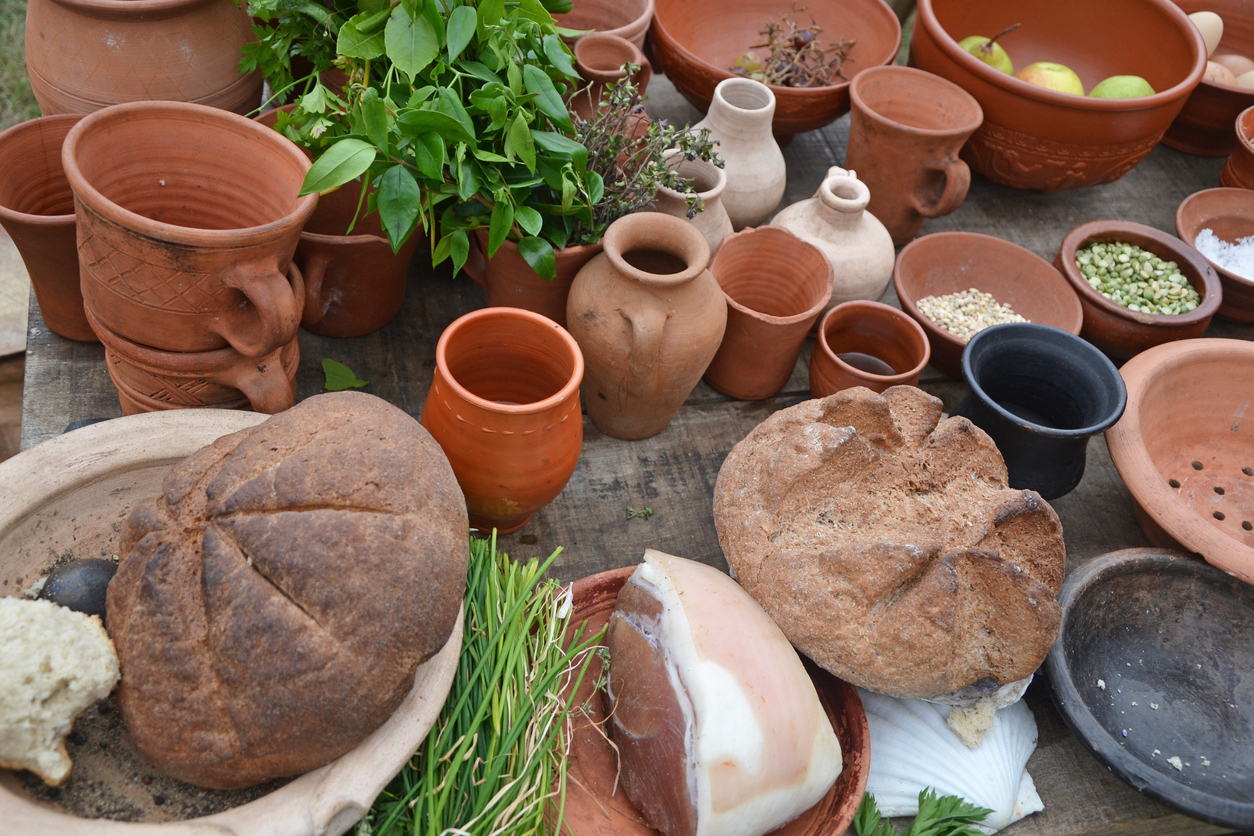
The family’s table would be a trestle arrangement that could be easily taken down and stored between meals. Food would need to be hung high in the roof, away from predators. They would eat whatever they could acquire from their animals, mainly chicken, pork, beef and lamb, their small plot of land for vegetables, and the hedgerows for berries. Their diet would be fresh as there were few ways of storing: salt was precious for preserving meat, for instance, and ice-houses only for the wealthy. They would drink ale rather than water which was often contaminated. Wine was rare in a ceorl’s house but frequently drunk in the chieftain’s hall. Bread made from spelt, rye or oats, could be baked in communal basic ovens. There was little sugar in their diet and skeletal remains show good dental health. For a sweetener they used honey from their own or communal hives, and this is one of the main ingredients of the favoured alcoholic drink of mead.

Water for washing and cooking could be collected in pots from the stream or village well, if they were lucky enough to have one accessible. The ceorl’s home would have a small plot of land outside the building for vegetables for the family’s use, and nearby a ‘midden’ or primitive toilet area, the contents of which would be used for manure on the vegetable plot.  

For more, you may like to read my novel A Shape on the Air, an Anglo-Saxon mystery time-slip, set in the present day and 499 AD grounded in detail on domestic life of the time, available at

http://myBook.to/ASOTA

Living with the Anglo-Saxons (2)

What did the early Anglo Saxons wear?

Certainly not animal skins wrapped around their torsos, the popular image of ancient Britons, nor togas left over from the Roman occupation of Britain! From the 5th to the 7th century clothing was perhaps surprisingly well refined and often richly dyed and decorated, especially for the higher classes of society. Of course, it depended on your social class, and the lower classes wore simpler garb of rougher cloth (working class serfs, peasants and even geburs who kept small parcels of land, and ceorls who were freedmen). But even so, the garb was not unlike our clothes today. For the higher ceorls and the thegns and their ladies, clothes were highly decorated and accessorised by brooches of gold and jewels.

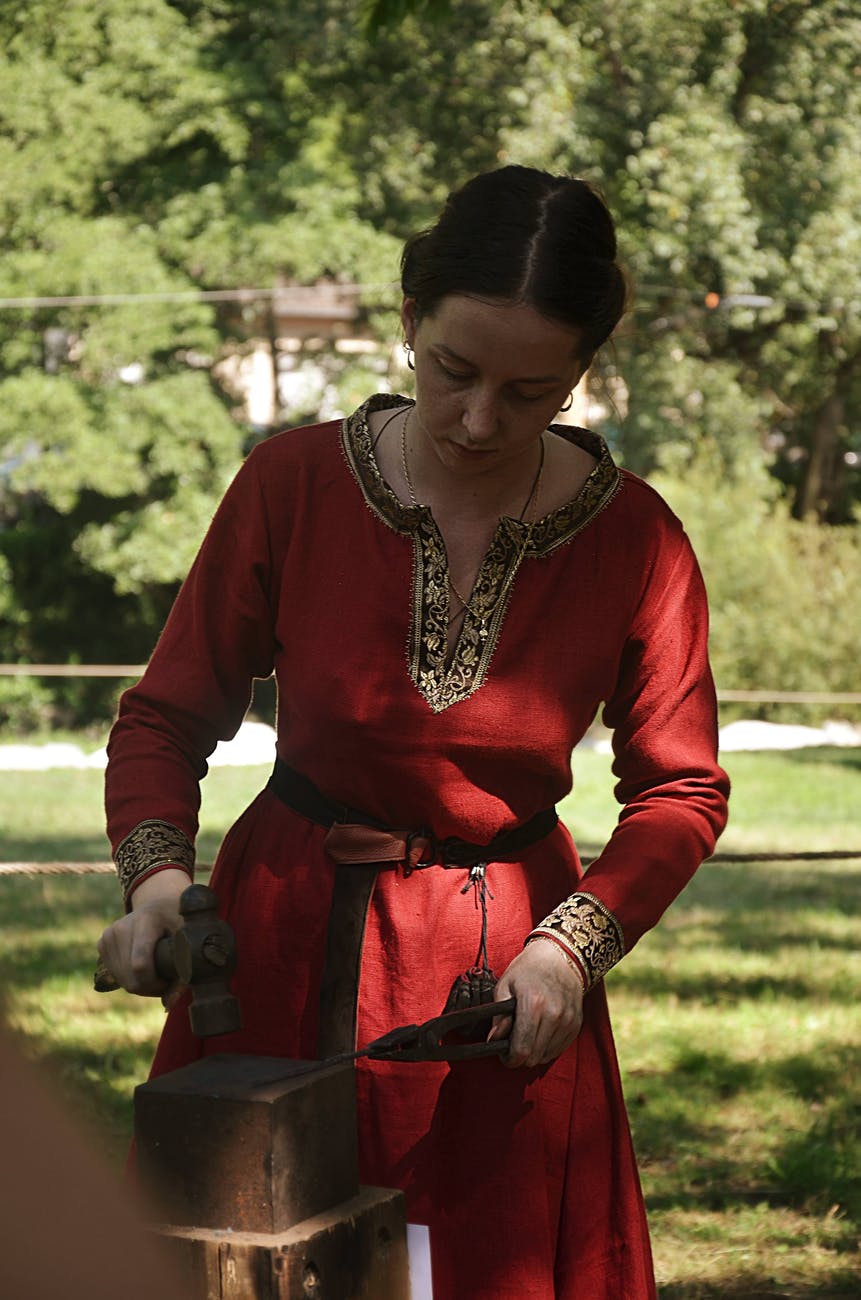
Upper class ladies often wore several layers, as heating even in the richest houses was rudimentary: a chemise or shift in linen or wool, then on top of this,  a long sleeved full-length under-dress, or kirtle, again of linen or wool or maybe a soft cotton fabric from lime tree fibres. On top was an over-gown dyed with more expensive dyes such as deep reds, purples and blues and lavishly trimmed with braid or fur. It would be fixed around the waist with a leather belt from which hung a pouch for keys and other valuables, a cross between a modern-day pocket and a purse or bag. On top would be an embroidered mantle or cloak fixed with a gold brooch at the shoulder, often jewelled or metalworked. Later in the period, kirtles would be fashioned with gores lined with silk or brocade to match the over-gown or trim.

Photo by Pexels User on Pexels.com

Ladies’ hair would be twisted and bound or braided. Unmarried girls wore their hair more loosely. Headwear for ladies was a head rail often decorated with silver-work or jewels which fixed the veil beneath. Later, ladies tended to wear a type of wimple and veil reminiscent of nuns or a coif or crespine.

What of the men? As you might expect, theirs were simpler than the ladies. Men of lower class would wear simple tunics, often rough-spun with hose beneath, with higher class thegns and above sporting woollen or linen undergarments and woollen hose beneath their tunics topped with heavy fur-lined cloaks, fixed with gold brooches. Heavy leather belts held daggers and knives not just for fighting but for cutting food in the mead hall feasts.

Photo by Maria Pop on Pexels.com

For more about Anglo-Saxon life, why not read my novel, A Shape on th Air, a time-slip from the present day to 499 AD

http://myBook.to/ASOTA

Living with the Anglo-Saxons (1)

Were there different social classes in the early Anglo Saxon period?

Photo by icon0.com on Pexels.com

We can see that throughout history and different cultures, society organises itself into groups and subgroups, usually based on religion or economic standing. In early Anglo-Saxon Britain there were social classes, in some ways similar to our modern understanding of hierarchies, in that there were ‘higher’ and ‘lower’ social classes, but in some ways they were very different from ours today. Anglo-Saxon and Celtic-British settlements were becoming increasingly expansive as the external threats grew. It made sense to band together for security and ‘manpower’. Settlements were headed by the chieftain, or ‘cūning’, from which we derive the word ‘king’. Even where the settlement was headed by a queen (rare!) she was still referred to as the ‘cūning’ in Anglo-Saxon. The word ‘cwene’ (queen) was usually only used for the wife of a king. The heir to the chieftaincy was the ‘ætheling’. Then there were the ‘ealdormen’ (elders) and the ‘thegns’, who were the nobles who were entitled to fight for the king at the head of troops and lead warriors into battle, and thus highly regarded. They often had their own family crests and banners which they fought under.

In early to mid-Anglo-Saxon times, society was strictly hierarchical. The view of society was that people were either freemen (the thegns and ealdormen, owning their own land and goods, often very wealthy, especially if in favour with the king/ cūning) or freed-men (ceorls, granted their freedom but of a low social class), or grant-bearers (the geburs, allowed to work their own small parcel of rented land but still bound to the king) or peasants/servants (villeins bound with no land). At the lowest level of this hierarchical society were the serfs and slaves. It was the chieftain/cūning who personally determined the level of freedom anyone was allotted. In the more enlightened communities social climbing could be allowed, if you kept in the cūning’s good books! Otherwise you were trapped for life: there was no social aspiration through education, for example, or business, and rarely through marriage as alliances amongst the higher levels of society remained politically expedient, not for love – and certainly not for the love of someone in a different class!

http://mybook.to/ASOTA

How ‘primitive’ was the early Anglo-Saxon period?

Photo by Pixabay on Pexels.com

Was the early Anglo Saxon period ‘primitive’? part 1: the legacy of the Romans

So, before the advent of the Angles, Saxons and Jutes from the European continent, Britain was now embarking on a new age, alone without its Roman protection and orderliness. But was it ’dark’ because it was primitive, ungoverned, lacking in culture and sensitivities?

What happened to the culture and yes, even spirituality of Roman times, and of pre-Roman Britain? Religion, beliefs, gods and their effect on mankind were strong influences on Roman life, demonstrated in their art and craftwork; icons and imagery of beliefs or superstitions (call them what you will) were rife. Did it all disappear in the early to mid-fifth century AD?

Or was Britain ‘dark’ because we simply don’t know to any degree of certainty, because of the paucity of archaeological or documentary evidence, what it was like? So, what if all that did not crumble and disappear from everyday life after the Romans left Britain? After all, why should it all be forgotten in the disappearing flash of Roman swords from our shores? Wouldn’t the British still retain something of their Roman past and indeed of their pre-Roman ways?

Today, we still have our Roman roads, our sites of Roman towns and villas, some have been adapted, some in ruins. Were these splendid constructions simply abandoned in the early fifth century AD and left to rot as the occupying forces left, as we have long believed?

Was the early Anglo Saxon period ‘primitive’? part 2: a mix of cultures

I argue that during the long Roman occupation, rather than two opposing and alien cultures, there would have been a mingling, intermarriage between the ‘invaders and the ‘native’ Britons, Celts, and other groups, that these resulting communities would have perhaps settled, compromised and accommodated each other’s ways.

After the withdrawal of the Roman legions and administrators, the people, the so-called ‘abandoned’ Britons and remaining Romans who had established homes and families after inter-marriage, would have used Roman effects in their subsequent buildings and settlements, and likewise would have retained aspects of their cultural heritage that were important to them, their craftwork, their art, their beliefs.

Granted, there would have been challenges and tensions between different cultures which by the late fifth century would have comprised a complex mix deriving from native groups (Celts, Britons), remaining Romans, occupying warring migrants in the northern territories (Picts, Scots), and new migrants (Saxons, Angles, Jutes). Many Celtic-speaking Britons would have adopted the Christian religion of their forebears and of many converted Romans, yet with the sweep of the Saxons northwards after the Roman withdrawal, paganism returned before a more widespread Christianisation in 597 AD with Pope Gregory’s emissary St Augustine.

Archaeological evidence, including artefacts, indicate that there was a rich culture here which embraced imports from trading across the world: rich religious icons, amphorae for storing wine, red Samian tablewear, glass, gold, jewellery for example, as well as wall hangings, imported olive oil, wine and foodstuffs. Gradually the mix of cultures brought new ideas, skills and an increasing trade to create a wealthy and sophisticated culture in 5th to 6th century England.

Read more of this fascinating period in A Shape on the Air and its forthcoming sequels. Go to …

http://myBook.to.ASOTA

A Shape on the Air: an early Anglo-Saxon time-slip mystery. “a wealth of historical research”, “fascinating historical period”, “the atmosphere evoked is fabulous, “I just couldn’t put it down”, “the women in this story are both brilliant and strong characters”, “Both the story-lines (in the time-slip) are equally compelling … an amazingly delightful and fast-paced read!”

Who were the early Anglo- Saxons?

early Celtic/Anglo-Saxon cross in a Midlands country churchyard, England

The Roman occupation of Britain during the early fifth century AD began to disperse when Honorius requested the return to Rome of the legions and administrators. The remaining Romans who had intermarried with Britons and Celts, along with the ‘native’ ethnic groups with existing settlements across the countryside of England, strengthened their fortifications against marauders from north of the border. It seems that they had already established organised groups or small ‘kingdoms’ (I won’t call them ‘tribes’ which seems to me to connote primitivism) which were then strengthened and extended, possibly with settlements joining into larger groupings.

These ‘pre-Anglo Saxon’ kingdoms developed gradually as Angle, Saxon and Jutish migrants from northern parts of Europe headed increasingly for Britain, perhaps for land, crops, climate. From around 450 AD, the Anglo-Saxon-Jute communities began to grow, bringing with them their heritage and culture.  

We have long perceived this time as mysterious, dangerous, even barbaric, as ‘invaders’ fought brutally to gain land from the indigenous peoples. The idea, long held, was that as the glory of Rome had gone from our island with the withdrawal of the legions, the British had no defence against the invaders, and that eventually the indigenous ‘tribes’ were overcome and suppressed by the brutal Anglo Saxons. One version has it that the threats to Celtic-British communities or small ‘kingdoms’ led Vortigern, High King of the southern Britons, to call upon Angles, Saxons and Jutes from overseas to help quash the Picts and Scots who threatened his land.

The threat from the north appears to be real but the actions of Vortigern, and indeed his very existence, is disputed. Brutish Anglo Saxon invaders, or migrants who, by and large, integrated relatively peacefully into Celtic-British society? What’s your view?

By the way, the photograph at the top of this post is the original inspiration for the third in the Dr DuLac series, The Rune Stone. It’s called locally, the Saxon cross, but it bears evidence of earlier Celtic influences and suggestions of a very early Celtic/Anglo-Saxon settlement can be detected in the village.

http://myBook.to/ASOTA

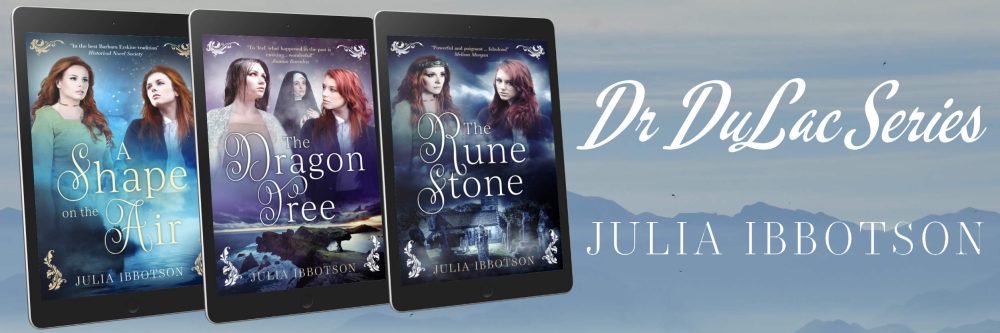
http://myBook.to/TDT

http://myBook.to/TRS

Which books make me cry? And 10 fun facts about me – hmm!

My book tour continues! Today I’m interviewed by Jasmine at http://bookreviewsbyjasmine.blogspot.com

She asks me about the books that made me cry and if you scroll down there are also ten fun facts about me that you never knew!

  1. What is the first book that made you cry?

Little Women (Louisa May Alcott) because I was mad with Jo and I thought that the gorgeous male protagonist married the wrong person (trying not to give spoilers). I was very young! Then One Day (David Nicholls) and latterly A Single Thread (Tracy Chevalier). I cry very easily, at just about everything! I even cry at my own books; A Shape on the Air, for example – what happened with Dr Viv’s partner, her mother, betrayal, Lady Vivianne’s betrothal, the mystery they had to solve … I’m almost in tears now!

  1. How long, on average, does it take you to write a book?

I usually reckon 6 months for research and 6 months to write the book. Even if I know the historical research base well (as with early medieval/Anglo-Saxon England which was my original research field), I have to research specifics for that particular book. For A Shape on the Air I had to research minute details of daily life in 499 AD. The same with my Drumbeats Trilogy, which begins in Ghana, West Africa in the 1960s, even though I had lived there I had to research the locations and what was happening at that time (music, books, politics, current events, etc). I love reading about how people lived in a different historical period so it’s a joy to do the research. My problem is where to stop!

  1. How do you select the names of your characters?

Oddly the names often arrive in my head before the complete plot. I tend to have a character and inciting incident/initial situation/conflict before I start. I always have a ‘mood board’ for each novel WIP on my pinboard beside my desk and when I have a picture of my character on it, the name follows pretty quickly. Maybe because when I sit in a restaurant/bus/train and do my naughty ‘people watching’ I give them names as well as jobs and situations. For A Shape on the Air, I chose a picture of Rachel Weiss and thought of Dr Viv, and James Norton and thought of Rev Rory. Don’t ask me why! But it’s also true that I had to find similar names that fitted both time periods: Dr Viv in the present and Lady Vivianne in 499 AD, Rev Rory/Sir Roland, Tilly/Tilda, and so on. I decided not to use completely authentic  names for 499 AD as the characters were from different ‘tribes’ or ethnicities (Roman, Celtic, Briton, Saxon etc) and some would not be so easy to read for the modern reader. For myself, I always found it hard to read names I have to really concentrate on to remember.

  1. What creature do you consider your “spirit animal” to be?

I’d like it to be a wise owl or an elegant horse or gazelle, but it’s probably a cat (curled up by the fire and looking piercingly at what’s going on around).

  1. What fictional character would you want to be friends with in real life?

Cormoran Strike (Robert Galbraith aka JK Rowling). I think he’s fascinating, hard but a softy at heart. He’s had such interesting experiences and I think he’d be full of anecdotes. I feel he’d keep me laughing as well.

  1. Do you have any advice for aspiring writers?

Don’t give up; keep at it and believe in yourself. Read through your finished draft as though you are the reader, not the writer; if it doesn’t capture your attention throughout, then it won’t for anyone else. Make a great opening that grabs the reader’s attention and a great ending that makes them rave about your book. Create memorable characters and get to know them inside out: make a profile of them, what do they look like (very important), what are their little foibles, what are their likes/dislikes, what’s their history? And for heavens’ sake, do your research!

  1. What book do you wish you had written?

Kate Atkinson’s Time After Time.  Brilliant. What an intriguing concept: what if there were different ‘realities’  and history could repeat itself, but change for the better (hopefully). It’s a bit like a time-slip, I guess, but one that actually alters history – something we normally try not to do in time-slips – for the benefit of mankind.

  1. Tell us 10 fun facts about yourself! 🙂
  • I love rhubarb and ginger gin and hate beer
  • I like rugby (watching!) and hate football
  • I love walking in the countryside and hate running (mainly because I have a spinal injury)
  • I love baking for family and friends: my current specialisms are ginger flapjacks (there seems to be a ginger theme going on here!) and almond macaroons, granary bread, and cauliflower & blue stilton cheese soup
  • I love crime novels, police procedurals and psychological thrillers, but I could never write them
  • I like gardening and growing my own vegetables and fruit
  • I’m really into healthy eating – all things fresh and homemade, not shop-bought, plastic wrapped and transport-miles
  • I actually have a PhD! In socio-linguistics, how men and women talk to each other. The research was fascinating!
  • I’m a qualified yoga teacher
  • I love clothes but hate shopping and changing rooms

And there we have it! That’s it for today. Let’s see what tomorrow has in store …

Early history: the ‘dark ages’; time slipping; the time-space continuum – Getting it right

The second day of my book tour and I’ve just stopped at the lovely spot: Books, Life and Everything (I love that name!), for a guest post.

https://bookslifeandeverything.blogspot.com/2020/02/a-shape-on-air-by-julia-ibbotson.html?m=1#more

So, this is what I said …

Researching for a time-slip novel

Anybody else, like me, love the historical novels of Philippa Gregory? History, intrigue, mystery, romance, drama, tragedy – it’s all there. I’ve learned much of my knowledge of the Tudor period from her work. Even though I know they’re novels and not non-fiction academic texts, I still trust that they are reasonably accurate albeit a fictionalised ‘take’ on characters of history. I do know that she has done her research, even though you may disagree with some of her interpretations!

All the authors I know do a lot of research before and during writing their novel, but it’s especially vital if you are writing about a historical period, or a location or a concept, because you have to get it right! There are, believe me, many readers waiting to jump on the slightest inaccuracy – and that’s understandable, and quite right. Readers want to see the novel, even if it’s a fictionalised account of the time or place, as an authority. When I read such a novel I want to feel I’m learning something correct and authentic, not something wrong.

For A Shape on the Air, I had a plot involving Dr Viv DuLac slipping back in time to 499 AD to solve a mystery, so I needed to update my research on the early medieval period and also to research concepts of time. Both of these are areas I love to read about, so it was no hardship. I’d studied medieval language, literature and history at university for my first degree and was fascinated by the Dark Ages (after the Roman rule ended and the early Anglo-Saxon settlements began). There wasn’t (and still isn’t) very much researched and written about the Dark Ages, which is where it got its name, not because it was violent and barbaric (which is what many people think) but because of the lack (darkness) of evidence in archaeology and documents. In some ways I had to use my deductive powers to assess what might have been retained from the earlier Roman period and what might be developing forward into the Anglo-Saxon period. More recently evidence is now appearing, such as from the ‘dig’ at Lyminge in Kent, England, where a fifth century feasting hall had been unearthed not long before I wrote my book. And there is a growing body of archaeological, geophysical and isotopic evidence to indicate how the people of the 5th and 6th centuries lived. But I had to keep up to date with new discoveries, all the time, keeping revisiting published research documents. So there was a fair amount of both evidence and informed imagination at work as I wrote A Shape on the Air.

My research into time-slip was also fascinating. I looked again at the scientific theories of quantum mechanics, which sounds a bit like something from Dr Who, the Einstein-Rosen Bridge, and worm-holes, all basically ideas about space-time portals through which you could slip from one layer of the universe into another, or from one historic period into another. Fascinating, especially for all those who like fantasy and the paranormal, and yet these are real scientific theories of the concept of time, albeit unlikely to be tested by experiment! Strangely enough, I seem to be hearing those theories quoted so much more these days in the media. So maybe something out there is catching on!

Time-slip sounds insane, and of course Viv (in the present day) wonders if she’s going mad when she thinks she’s had a dream but brings back a real golden key from 499 AD! And her ‘dream’ is so real she begins to wonder if she’s taken on the identity of Lady Vivianne, her counterpart in the Dark Ages. How do they fit together? Why are their lives becoming intertwined? Why do they need to reach out to each other across the centuries? Well, I’m afraid that you’ll need to read it and see …!

http://myBook.to/ASOTA

Book tour off to a great start in USA and UK

My book tour gets off to a wonderful start! Two lovely reviews today: the first from Laura’s Interests at https://dogsmomvisits.blogspot.com/2020/02/a-shape-on-air-by-julia-ibbotson.html

She says: “Seamlessly slipping us between eras, this book combines the elements of mystery and romance with dangerous precision.  It appealed both to this historical fiction lover in me and the mystery lover. With great details and wonderful characters, I was drawn deeply into the book and easily blocked outside distractions.  Great escape read.”

And the second, a very long, thoughtful analysis from Radzy at Vainradical.co.uk 

“A Shape on the Air is a dual timeline novel set in both present day, and 499AD, with our main character, Viv (in present day) and Vivienne (a presumed ancestor) as they combat betrayal, heartache, and the times they’re in. This is a tale of female empowerment tossed into a healthy helping of romance and adventure, with plenty of vivid imagery to boot.

My favourite part of this novel is easily the imagery. Ibbotson doesn’t dote on minor details, and rather gives us a large picture with just enough fixtures for our minds to piece the rest together. This style allows us to become lost in the world we create, while allowing fluidity and simple fixations – such as the wonderful sounding food and drink, the fabrics, and of course the handsome Roland. I found myself wanting to have medieval breakfasts, coffee with cream and a little honey, and to touch luxurious clothing. Viv is a woman who doesn’t scrimp on what she finds joy in, and things come across extravagant and wonderful. Vivienne is from a simpler time, but the way she finds comfort in swishing, soft fabric on her feet ties the two character’s personalities together well. They’re the same woman, if we’re honest, but Ibbotson has created them to be different enough, that I could tell them apart with ease, but sought their similarities as well. They’re quite vain women, not afraid to sing their own praises, and Viv at least sees her physical prowess as her strength, rather than what’s in her mind, but she’s equally a well-educated, impeccably spoken young woman. Their ages are never spelled out explicitly, but I assume Viv is in her early thirties, there’s no way she’s not, where Vivienne I’d assume is a decade younger. This fact doesn’t matter, but something I found myself thinking about, comparing her life to mine, and how her achievements are reachable, but worked very hard for. I think what I’m saying is that this novel makes you feel something, unexpectedly, but well received. I enjoyed thinking about food, and hot coffee. I loved thinking about swishing fabrics and cold, unyielding water. This novel is sensory, in a way I didn’t expect, yet highly recommend for that sensation.

But let me quickly get back to something I just mentioned. Both women are vain, and that’s a trait which often turns me away from romance novels. The women are always perfect, gorgeous, and everyone wants them. This doesn’t steer away from that enough to not put me off a little, especially with how other characters are described to not overshadow our leading ladies, but this doesn’t take over the story, so I could easily look past it. It’s not something I’d be aware of if you’re looking to read this, or something to bear in mind, especially if romance novels are something you love, but it’s not something I personally enjoyed. Female empowerment doesn’t need to come at the expense of others and describing the former friend as ‘homey’ and ‘comfy’ and ‘how could he want her when I’m here’ is combative. True to character, yes, but combative.

That said, I truly enjoyed the same plot essentially being told twice, but suitable to a t to the time. Viv opens the novel cooking a delicious sounding dinner for her and her other half, Pete, when he comes home and says he’s leaving her. He’s been seeing someone else. Rapidly, Viv’s life starts to spiral – Pete has already taken most of her money and is now seeking to sell their flat and take more money he’s not entitled to. This man we were introduced to in Viv’s mind as handsome, sweet, and loving, is conniving, selfish, and infuriating. He’s the perfect representation of when a human forgets others have feelings too, and becomes so wrapped up in themselves, they take full advantage of everyone. His ex could become homeless, he doesn’t care. She’s been paying 75% of the mortgage. He doesn’t care. Her career could suffer from his pure selfishness. As long as it’s not his business suffering – he doesn’t care. Pete, this sweet man we were promised, is disgustingly self-absorbed, and this shift is jarring – and perfectly suited to the hurricane of emotions Viv finds herself in. On the flip side, Vivienne is a young woman, living in her late father’s kingdom, but forced to be at the will of her ‘guardian’, Sir Pelleas, who is only desperate to wed her, force her to have his child, and be his doting wife, so he can have her kingdom and riches. Unlike Pete, Pelleas is never shown in a good light, which I liked (I do love when authors aren’t afraid to just make fucking awful people, even if I hate them with a passion, it’s a skill) and Pete’s actions are faintly mirrored by Pelleas, with about a year’s difference. Pete was seeing the other woman, he was colluding with her, and then they strike. It’s obvious they’ve been seeing one another for a while, and as it’s declared the other woman is pregnant a couple days after Pete leaves Viv, we can only assume this is what made him finally go. Pelleas on the other hand is still plotting, working with Vivienne’s lady in waiting, and seeing her behind Vivienne’s back. The two storylines are very similar, but told in carrying enough ways, with the trials and tribulations of the times, to be different enough to be enjoyed. I also think at some point I should mention Roland, or his modern equivalent Rory, the excruciatingly handsome man who just wants to see Viv, or Vivienne happy, and doesn’t mind being a tease while doing so. He’s sweet, wonderful, and the perfect leading man in this genre. I bring him up because there’s a trend in fiction to create brooding, hard to reach, so tantalising, men, but Ibbotson doesn’t bother with that. The good guy is great and kind, and the bad guy is an ass. There’s no teetering between, or the sullen hero who needs saving, and this was refreshing. I loved just being able to enjoy Roland/Rory, and how sweet he is. If you enjoy a novel where your main men aren’t all broken and need piecing back together, this is a book to check out.

This is also a book to check out if you love timeslips, well researched historical novels, and stories of strong women defeating evil, and getting their happy endings. There are characters who you’ll want to scream at, and moments you’ll melt over, and overall, even if romance isn’t you genre, as it isn’t mine, if you love well-constructed, dual narration, mirrored novels, I’d recommend this.”

Great reviews and interesting comments from both – thank you!